Metal culture is a global phenomenon that generally transcends nationalistic borders, and as an American Metalhead I like to stay as informed as possible about global attitudes and trends regarding heavy metal.
For example, I’ve written on the illegal promise of a local government to allow the Roman Orthodox Church in Romania to “approve” what bands are allowed to play in the country. This promise was in direct violation of Romania’s constitution – and the government’s silence is the equivalent of supporting this sort of discrimination. Not OK. And small decisions like this have greater cultural implications – if you allow a non-governmental entity to determine governmental policy (including disbursement of public funds), you’re allowing that non-governmental group to make governmental decisions
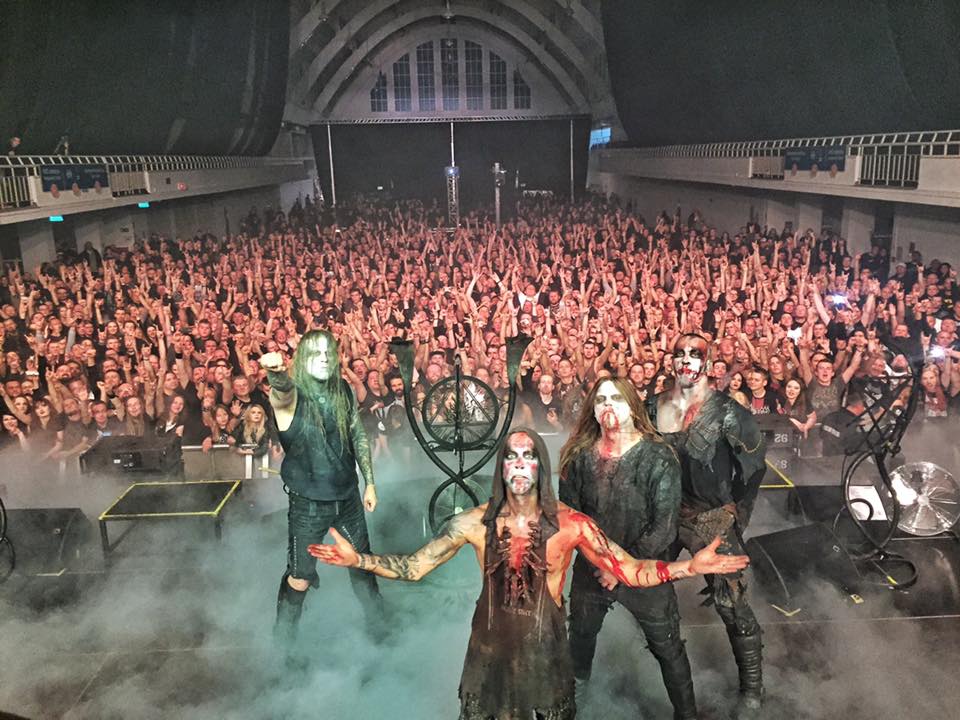
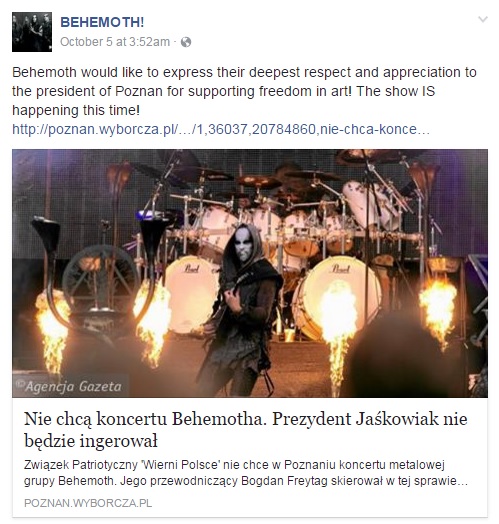
This is where a recent political decision from Poland comes into play. Since roughly 2007, religion-based political groups have been petitioning the Polish government to ban a list of musical groups they deem satanic from playing in the country. This list included Polish natives Behemoth.
Around the same time, Behemoth front-man Nergal controversially destroyed a bible onstage during a show, and criminal charges were filed against him (I think it’s safe to say there’s no love lost between Polish religious groups and Behemoth). The ensuing court cases stretched over a number of years (until around 2012 I believe), and the last I checked he was acquitted. No surprise – after all, he’s kind of a big deal in Poland.
Then in 2014, a scheduled show in Poznan, Poland was cancelled due to vague “safety concerns”. Nergal rightfully called out the actions of those in power for what they were – political maneuvering to placate religious fundamentalists while avoiding controversy. Article 73 of the Constitution of the Republic of Poland guarantees freedom of artistic creation and scientific research, as well as free access to cultural goods. The real violation of civil rights was not perpetrated by Behemoth, but by the church against the band and their fans.
Enter 2016 -Bogdan Freytag, chairman of the religious protest group “Faithful Poland”, petitioned Poznan’s Mayor (Jack Jaśkowiak) in the hopes of preventing Behemoth from playing yet again. Considering the incredible amount of legal power these religious groups have wielded against the band, I feel it was a bold move in the right direction for the president of the country to allow the concert to happen. Behemoth seems to think so too.
At this point you might be asking yourself, “Why is this important?” Well, simply put, it sets an example for other countries in Eastern Europe in favor of free speech, even if that speech offends the church. Which (from what I gather) is a concept that hasn’t fully taken hold in the area.
Essentially, Poland has done exactly what Romania should have done. Because if you look closely, there’s a pattern here – religious groups exercising their constitutional rights in a country for the express purpose of denying those same rights to a large segment of the population. It happened in Poland in 2007, and it took almost a decade to undo the damage. That’s why it’s important to put a spotlight on small local governments making seemingly innocuous concessions to religious groups (or any protest groups) – because those decisions set a legal precedent with far reaching legal implications.
So, in the greater scheme of things – Behemoth’s ability to finally play in Poland is a victory for free speech (and metal).
First and foremost, I feel the need to thank a peer and comrade at arms in the ongoing quest for intellectual discourse and discussion in the arena of metal and heavy music. Hornsofaradia wrote an excellent article detailing arguments for the inclusion of rock music in the metal family tree. Thank you very much for the kind words – I hope to continue to live up to them.
Rock v.s. Metal
So, this is a rather large topic to tackle – and I guess the best place to start is the beginning. I don’t believe there is a way to accurately include all of rock and roll into the metal family tree because of the incredible amount of diversity between the two genres.
They’re unique and distinct, with some areas that overlap. For example – it’s a genre that includes bands like Ghost, Rob Zombie, Godsmack, and Disturbed. Every single one of these bands has been referred to as a “metal” band at some point in their career – in fact the latter three self identified as metal until what is commonly referred to as the “New Wave of American Heavy Metal”. At this point there was a mass shift in the collective mainstream musical consciousness, and these bands were “relabeled” as hard rock. It was a slow process – and if you weren’t really paying attention it was easy to miss. An argument can be made, at the very least, that they all (to some degree or another) play what could be referred to as “metallic hard rock” or “hard rock with metal influences” – this is an area where the relative fluidity of genre labels can be a bit frustrating. Whatever you want to call them, there is at least a little bit of metal in the DNA of these bands.
On the flip-side you’ve got bands like Coldplay, Radio Head, Nickelback, The White Stripes, and other bands that have exactly zero overlap with metal – culturally or sonically. These are bands and cultures that are completely dependent on the music industry, and are more akin to pop (and other artificial art forms) than they are to metal.
Then there’s Metallica’s “Black Album”. If we were to include rock into the heavy metal family – it would negate the premise that Metallica sold out when they made that album. The big problem people had with that album is that Metallica was playing hard rock (and had abandoned metal). This, by itself, to me illustrates the relative difficulty of accepting rock into the metal fold. Actually, this scenario would perfectly illustrate the analogy of fission v.s. fusion. With fission – a large amount of energy is released – but it’s nothing compared to the destructive force of fission. The amount of negative energy released just in the realm of Metallica discussions would probably break the internet.
Regarding the Current State of Rock Music
You know, it’s funny. Hornsofaradia actually broached a few topics I’ve been mulling over in my head for a while now (with the intent of blogging my thoughts on them in the indefinite future). The current lack of a market in the rock category (specifically hard rock) and the reasons for it is a major one, as well as related topics (i.e. what caused it, what will happen to rock culture moving forward, etc).
Essentially, I think what made rock so huge ended up being it’s downfall. The relative simplicity coupled with incredible marketability made it a staple of the music industry. The inherent bureaucracy of the industry essentially slit the throat of rock and roll and slowly bled it out for all it was worth. This combined with the current trend of the “indie” rock bands playing feeble, weak, boring music and labeling it as rock are – in my opinion – why you don’t see a lot of “up and comers” playing straightforward, hard hitting rock music.
Metal Culture’s Silent Support of Rock
There are a number of reason I think that there shouldn’t be too much concern about the current state of rock.
First and foremost – as I outlined in my post about the two faces of metal, there is a certain vein of the metal community that already considers “mainstream” metal nothing more than hard rock. There is a lot of validity to this argument – especially when you look at it in terms of generations of music listeners.
Today’s “mainstream” metal is tomorrow’s rock and roll. Hair Metal, Grunge and Alternative, and a lot of Nu-Metal bands (including but not limited to Disturbed, Godsmack, The Deftones, and Linkin Park) were considered heavy metal while the scenes were active. However, in retrospect these are the bands currently on rotation on mainstream hard rock radio stations. I contend that these patterns will hold true in the future – and bands like Avenged Sevenfold, Deafheaven, Liturgy, and the like will be relegated to the “rock” category as time passes.
In regards to the cultural impact of rock music – I do agree that the position of societal rebellion formerly held by rock music has been usurped by metal. This, I think, is the greatest connection metal has to rock music. When compared to most metal, rock music seems rather tame – in large part because it has been tamed by embracing the music industry. Not entirely – but metal continues to push the envelope (musically, lyrically, etc) while rock and roll stands still and stagnates.
So, in regards to a lack of a viable pool of bands to be inducted into “rock royalty” – the model has changed since the 90’s. Most rock bands aren’t initially considered rock bands anymore. They’re referred to under the umbrella term of “hard rock and metal” put forth by the record industry.
Why is this? I don’t think there’s a simple answer. Partly because people from previous generations won’t accept newer “rock music” being categorized in the same group as Zepplin and Hendrix. Partly because mass perception of rock music (especially in the USA) is predominantly neutral to negative. People would rather identify as listening to metal than rock in most cases. I fucking hate it, personally.
Guns and Roses aren’t metal, Nirvana isn’t metal, Motley Crue barely makes the cut, Avenged Sevenfold aren’t metal, Disturbed and Godsmack aren’t metal, Rob Zombie kind of strides that line between rock and metal (but most of his stuff is just hard rock), KISS isn’t metal. These are all hard rock bands that were considered “metal” by the mainstream at the peak of their careers and their respective music scenes. Of course, my definition of metal is the music that, even 30 years later, won’t make it to mainstream radio. You’re never going to hear “Raining Blood” on KROCK, or any Slayer for that matter. So I’m not saying it to be mean, or an “elitist” in the derogatory sense that most people use it – I’m saying this because once a mainstream’s “metal” phase has panned out they get relegated to hard rock. This, as a rule, has held true since the fragmentation of metal culture in the 80’s (and in scattered instances beforehand – it’s hard to categorize metal bands before the thrash/glam split because they’re still very closely associated to hard rock).
So, in this sense, metal has been silently keeping rock and roll on life support for over 30 years. Every generation or so the “gateway bands” (mainstream metal) are used as an organ transplant to keep the hard rock machine alive and ticking (along with legions of new fans who never progress to the harder stuff) – while metal reaps the benefits of an ever expanding base.
Moving Forward – the Future of Rock and Metal
Also, kind of an interesting aside is metal artists who have hard rock side projects. This seems to be more of a European phenomenon (I notice they make much less distinction between rock and metal, or at very least embrace a ridiculous amount of diversity on a tour/festival ticket). Bands like the Gentleman Pistols (with Bill Steer from Carcass) or Spiritual Beggars (Michael Amott, ex-Carcass/currently in Arch Enemy) demonstrate metal artists love of rock. Labels like Nuclear Blast have a strong rock catalog, and continue to sign new rock artists from around the globe.
So, while I understand (and agree with) your concern regarding the apparent death of rock and roll – I think it might be helpful to take a step back and look at musical patterns throughout history. The industry has raped and pillaged hard rock for decades – so there is a necessary “incubation period” where rock and roll needs to go back underground and reform as an organic culture. It happened with metal – after the “thrash revolution” extreme metal went almost fully underground (with a few bands like Pantera carrying the flag through the 90’s) for nearly a decade. It re-emerged, slowly at first, with the “New Wave of American Metal” – which in turn sparked a metal revival. We’re still feeling the effects of this revival – with a lot of the classical forms (death, doom, black, classic, etc) experiencing revivals across the world. I hope rock will experience a similar pattern of revival – but even if it doesn’t, they get to draft a new swath of yesteryear’s mainstream “metal” bands into the fold with regularity.
Considering the often symbiotic relationship between hard rock and metal, I don’t think metal culture will ever allow rock to die out completely. Something a lot of people don’t talk about is the fact that becoming a metalhead is a multi-faceted process, not just a black and white event. You don’t just pick up a CD and suddenly become a metalhead – (almost) nobody starts off listening to Cannibal Corpse and Behemoth. You start off with rock, and eventually that doesn’t “do it” for you any more. Then you step up to hard rock, and get a taste of mainstream metal bands. I call this the “coffee drinker” model – you start off with a lot of sweetener and (generally) lower levels of caffeine, and then over time you adjust and start drinking stronger coffee – until eventually you’re drinking double-stuff black coffee with a shot of espresso.
In this sense, rock and metal will always be linked – because you have to start somewhere.
Conclusion
In keeping with the elderly relative analogy – I completely understand the comparison to with rock and metal. And I agree wholeheartedly with the components of the analogy. Rock, for all intents and purposes, is the elderly parent of metal – and is in trouble right now. But I disagree with the concept of needing to adopt the parent on a few levels.
First, I think that the baggage that comes along with rock music (fanbase, relationship to mainstream media, etc) is more than metal will allow – in fact, it’s a big part of the reason they split off in the first place.
Secondly, I think it’s a disservice to the inherent dignity of rock music. Like a proud, accomplished parent – the inherent independence of rock music is one of the qualities that keep it going. And for metal to adopt it into the fold would be to remove this sense of independence and dignity, and in the process would accomplish the exact opposite of the original goal. It would make rock music completely dependent on metal culture.
Like relatives that don’t get along (mostly because they’re so similar) – I think metal and rock are akin to family members who occasionally badmouth each other in public, but maintain a subtle relationship. Rock keeps sending new fans to the metal scene, while metal silently supports rock in subtle ways that allow rock to save face and retain a semblance of independence. If rock needed an organ transplant, metal would be the mysterious “anonymous donor” – they’ll save rock and roll, but won’t take the credit for it. Thus, the relationship can be viewed as a form of mutualism – a symbiotic relationship that benefits both parties (as opposed to parasitism, which I feel would be likely to happen with the induction of rock into the metal family tree).
All human social groups share certain characteristics – on a micro level (individual interactions) and on a macro level (large-scale group dynamics). For the purposes of this article, I could choose any large social group in the world – religious or otherwise. I chose to use Christianity for two reasons.
First, the rather tenuous relationship between Metal Culture and Christianity since February 13th, 1970, when Black Sabbath released their first album.
Second – heavy metal collectively has the largest and most loyal global fanbase of any style of music (at least according to statistics released by music streaming service Spotify). Considering Christianity has the largest following of any religion on earth, they’re probably the best point of comparison (i.e. the largest faith based and entertainment based communities in the world). And you might be shocked at the number of similarities between the two.
Please keep in mind this is an observational piece, and is by no means all-encompassing. On to the discussion.
Similarities:
Both are large-scale global “bricolage” cultures
Metal and Christianity are global phenomenons, with legions of dedicated fans/followers on every populated continent. Christianity and Heavy Metal transcend language and culture, as well as economic barriers.
Christianity broke off/fractured from it’s parent culture (Judaism) when the population base reached a critical mass. It later fractured into distinct branches (Orthodox, Catholic, then Protestant with Martin Luther), which have continued to splinter into smaller sub-groups. The sheer number of different denominations is staggering, but all of them fall under the larger umbrella term of Christianity.
Metal broke off/fractured from it’s parent culture (Rock and Roll) when the fan base reached a similar critical mass. It later fractured into two distinct branches (Mainstream and Underground/Extreme), which have continued to splinter into smaller sub-genres. The sheer number of different sub-genres is staggering, but all of them fall under the larger umbrella term of Heavy Metal.
Both Share Similar Spectrums of Adherence
In both Christian and Metal cultural groups there are spectrums of adherence that range from exclusive to inclusive (and everything inbetween). This is a natural occurrence – because as the population of a group increases, so does the number of different opinions within that group.
A good example would be the “real” or “true” member debates. Within Christianity, there is an ongoing discussion in terms of what constitutes a “real” or “true” Christian. A parallel can be seen in the whole “real” or “true” metalheads v.s. posers discussion. in other words, both cultures have their fair share of “infighting” over multiple definitions of adherence.
metal infighting
christian infighting
Have you ever heard someone say, “Why do we need all these subgenres? Why can’t we just call it all metal like we used to?” or something similar? Spend enough time on metal forums, Facebook groups, or with metalheads in general and you might notice it’s a rather common topic of discussion.
Interestingly enough, when discussing the relative diversity of Christianity with Christians I’ve heard similar sentiments (We don’t need all these different denominations/I don’t know why we can’t just call it all Christianity).
There is some merit to these arguments, because all sub-genres and scenes fall under the greater spectrum of Heavy Metal just like all protestant and catholic denominations fall under the greater spectrum of Christianity. So, they’re accurate – just not very specific.
Both are Historically Male-Dominated Cultures
Considering both Christian and Heavy Metal culture are derivatives of Western Culture (which is mostly male dominated) this shouldn’t be that much of a surprise.
There is a major difference here though – Christianity was systematically set up to exclude women from positions of power pretty much since it’s inception. A good example of that would be the taboo against female priests/pastors. Metal, however, is masculinist (as opposed to patriarchal).
So, while both social systems formed with predominantly male influence – in this instance the difference is a huge one. Within the church’s social structure – rules have to be changed to allow women to serve the culture in major roles such as a priest or pastor.
Heavy metal has no such restrictions. A women entering the metal scene simply has to navigate social norms that are traditionally considered to be masculine (I’m talking about the scene here, not the industry. All Western industry is patriarchal). The proof is in the pudding here, while the two systems may seem comparable, the end result(s) of the respective social structures for different genders can clearly be seen and differentiated.
Both Christianity and Heavy Metal Have Radical “Fringe Groups”
Both Christianity and Metal Culture have a few skeletons in the closet. Heavy Metal has such gems as National Socialist Black Metal and Hatecore (technically punk, like all of the “-core” derivations, but included here because of hardcore’s association with metal), while Christianity boasts the Ku Klux Klan, the Aryan Nations and other Christian Identity groups.
National Socialist Black Metal
Hatecore
“Fringe” hate groups in Metal
Aryan Nation
Ku Klux Klan
“Fringe” hate groups in Christianity
These fringe groups aren’t just about racism, anti-abortion violence in the United States and abroad generally has Christian undertones. And Heavy Metal has it’s own share of isolated, hate-filled violence. From the infamous church burnings and murders to instances of torture, it’s safe to say there are a few very seriously disturbed individuals on the fringes of the scene.
In both instances, the major block of the respective cultures renounce the violence of the fringe groups – but these events are so violent and atrocious it’s hard to separate them completely.
Both Have a “Ritual” Component
Sociologically speaking, a metal concert could be considered a ritual experience. Rituals aren’t limited to religious expression – for instance, shaking a person’s hand as a greeting is a common social ritual.
Black Sabbath Concert
Cannibal Corpse Concert
The metal concert is a ritual of heavy metal culture worldwide. Individual customs may vary based on location, for instance in the United States it’s generally considered taboo to wear the shirt of the band you’re going to see at a show (unless it’s a tour shirt purchased at the concert). However, in other areas of the globe this isn’t necessarily the case. Also, someone not familiar with the incredible variance of metal culture might not recognize that a Black Sabbath show and a Cannibal Corpse show are both considered to fall in the general realm of metal shows.
Southern Baptist Minister
Russian Orthodox Preist
Snake Handling Church
Likewise, a church sermon is a ritual of Christian culture worldwide. Traditions in American churches might seem foreign to those in Europe or elsewhere. Snake-handling is a tradition of some churches in the southern United States, while the custom wouldn’t be recognized anywhere else in the world. Someone not familiar with the relative diversity of Christianity might not recognize that a Russian Orthodox service and a Southern Baptist service both fall in the general realm of Christian ritual.
And in both cases, the end result of a successful “ritual” is the same – they solidify social bonds between participants.
Both Utilize an Atmosphere of Persecution to Solidify Their Respective Bases
This one’s kind of interesting – as both Heavy Metal and Christianity have a history of persecution. In fact, considering the universal symbol of Christianity is an instrument of torture used against the founder (the cross), one could argue that Christianity is based on a mindset of persecution. Likewise, the founder of heavy metal (Ozzy, through Black Sabbath) was publicly persecuted (granted, he wasn’t tortured and killed – once of the nice things about 2,000 years of cultural advancements, as an accusation of blasphemy has certainly led to public execution historically), most notably in his Suicide Solution trial in the 80’s.
Funny thing about a culture of persecution – it tends to solidify social bonds of the persecuted group and lend a universal sense of purpose through opposition of the invisible “other”. Metal bands and Priests/Pastors alike take advantage of this social mechanism rather liberally. I’m not saying it isn’t for good reason, in certain parts of the world Christians and Metalheads certainly are persecuted – and generally for the same reason. Because they both represent the spread of Western Culture in an area. Bearing this in mind, the tension between metal and christian cultures can be viewed in a different light.
Now, by definition these two groups aren’t mutually exclusive. You can be a christian (or a member of any other faith) and still be a metalhead. So, why is it that so many christian groups are against heavy metal? And why are so many metal artists and fans so vehemently against the christian church?
Short answer – on a macro level they’re after the same thing… membership. They might phrase it differently – Christianity generally says it’s around to “save people’s eternal souls”, while metal is generally there to “free people’s minds” and “promote individual thought”. But at the end of the day, the results are the same. A church saving a person’s soul generally implies participation in christian culture, and by inference the spread of that culture. Likewise, heavy metal grabbing a person’s attention and getting them to think for themselves usually includes participation and perpetuation of metal culture.
They Both Utilize Horror Themes
At first glance, this might seem ridiculous. But if you really break down the components of “Hellfire Preaching” and compare them to death metal lyrics, you’re likely to find a common denominator in horror themes.
In both instances, this is a manifestation of a culture catering to the morbid interests of their bases. Because at the end of the day, there isn’t that much difference between talking about people being tortured eternally in hell and singing about torture in any other medium. In this light heavy metal and hellfire sermons can both be viewed as extensions of horror themed entertainment. Because let’s face it, people like to be scared.
At first glance, this might seem like an odd phenomenon. In their current states, country and metal are polar opposites. And research into the personality type/musical preference connection clearly shows that fans of heavy metal have far more in common with fans of classical music than fans of country. But, the more you look at it, the more it makes sense that there would be a mini “exodus” from metal music to country. And, arguably, it’s a good thing for both genres and their fans.
Background
First and foremost, it needs to be mentioned that country and metal music share a common ancestor in the blues. Early rock and roll acts and early country acts were almost interchangeable – for example, Johnny Cash and Elvis toured together. Elvis is commonly referred to as the godfather of rock and roll (of which heavy metal is a derivative) and Johnny Cash is widely recognized as a progenitor of Country music. In fact, country music at it’s inception was simply a rural version of rock music.
Now, the two genres have had decades to evolve into two separate entities with distinctive fanbases and cultures that (generally) don’t overlap. But there’s always been a common thread connecting the two – the Rolling Stones “Honky Tonk Woman” is a good example. “Southern Rock” bands have kept a fusion between the two genres (rock and country) alive through the decades, but it wasn’t really until the 90’s that country music and heavy metal met and mixed.
No article dealing with the cross-cultural zone between country and metal would be complete without mentioning two bands – Pantera and Hank Williams III. These two groups bridge the gap between the two genres quite nicely. To further the connection – Pantera’s last real album (even though the lead singer, Phil Anselmo, wasn’t part of it) was a collaboration between the band and David Allen Coe entitled “Rebel Meets Rebel“. Artists like Kid Rock and Aaron Lewis from Staind have kept the connection going.
The Present Situation
Within the past year or so, there’s been more of an “exodus” of metal and hard rock artists in some form or another to the country music medium. Now, it’s not always a full blown transition, and it’s actually been going on for a while (technically since the dawn of both rock and country). I think it’s more accurate to describe the country/hard rock/metal phenomenon in terms of a spectrum: Dabbling (One-Off Country Albums, Collaborations)->Fusion Styles->Full Transition Between Genres (Including solo albums/projects).
As far as fusion styles – obviously guys like Pantera and Hank III go without saying. The mutual blues ancestor of metal and country music make them more compatible than you’d think at first listen. In fact, due to the Pantera connection we wouldn’t have groove metal without country.
And for full transitions you’ve got Kid Rock (This guy’s such a redneck, it wasn’t that much of a transition. I think he plays the CMT awards semi-regularly), Aaron Lewis (Staind), David Vincent (fucking Morbid Angel), and Danny Worsnop (Asking Alexandria). So we’ve got Metalcore, Death Metal, Blackened Death, Doom, Nu-Metal, Hair Metal, Hard Rock, Groove, and Prog represented in country music just from the bands mentioned in this article. I’d say that’s enough of a spectrum state that this isn’t a genre specific phenomenon – the appeal seems to be pretty universal among metal artists.
What Metal Culture Can Learn From Country
In terms of the metal community, a look at the current state of country is a sobering reminder that the music industry (all bureaucracy, in fact) can be a very toxic thing . So, as much as people like to go around bashing elitists – that particular core demographic of the metal community is a big part of the reason metal isn’t a shell of it’s former self. The pop machine has literally eviscerated the entire genre of country music, and left nothing but a hollowed out meat-puppet of a shell that they make perform for fans in a mocking, pandering sort of way. Don’t believe me? Check out this video.
This is what the pop machine does – it analyzes a core fan base to find things they like. It then arranges them into a palatable, pre-digested formula with literally zero integrity. Anybody who’s been alive through the 90’s should remember that country music was a pretty big thing back in the day. And in a matter of a few decades, it’s been reduced to a cultural and artistic void. Boots, cold beer, lemonade, lying in pick-up trucks, some sort of romantic rendezvous, and the month of July – hey, throw that in a 4-chord song format with a steel guitar playing in the background and you’ve got a #1 Country hit! Pandering at it’s best, there’s next to zero substance left in the genre. Probably part of the reason metal artists are occasionally dabbling – they’re filling the creative void.
Also, poser bashing is designed to prevent this sort of thing from happening in/to the metal community. Granted sometimes people take it a little too far, but sometimes you have to take the good with the bad. And in this case, a defense against entryism is much better than the alternative.
What Country Fans Can Learn From Metal Culture
Country music, as a culture, has zero defense against entryism. In layman’s terms, this means that there is no cultural “check” or way to stop an outside group from entering into Country music culture and changing it from within.
At first glance, this might not seem like a problem. It didn’t when Country-pop experienced a revival in the 90’s. But, here’s the problem. If any group can gain entry into an artistic culture – that includes a group put together by a record company. And their focus is on dollar signs, not art.
Unfortunately, because record companies already have a lot of money, they can afford to hire people to do studies into what the fanbase likes and doesn’t like (and then plug the results into the pop-machine formula). At this point, it’s not a matter of if or when it happens (because it already has), it’s a matter of what to do about it. I think that country music as a whole can benefit from a little “heavy metal sensibility”.
First and foremost, the artists getting into country are considered staples of their respective metal genres. These are top-notch artists with creative energy to spare. So, you’ve got a bunch of artists entering the scene and playing real music in the creative void left by the pop industry .
Second, I would hope they bring a little of that “elitist” attitude that has helped heavy metal stay out of the clutches of the pop industry for almost 6 decades. Combined with the DIY ethos of metal and punk, it just might be the breath of fresh air that country music needs.
Third, I hope a few metal artists reintroduce a bit more of that rebel attitude country music deserves.
Conclusion
I think it’s good for metal artists to branch out a little bit. Considering how saturated the market is with metal bands right now, it’s certainly not hurting heavy metal at all. And it could make country music tolerable again. Overall, I’d call it a win/win situation.
I’d like to start this by saying that I do not believe that there is an inherent bias towards or against female listeners or performers in metal culture. I think that there is a gender gap/dynamic, but this is only a problem in as much as the gender demographics relate to music in general.
I’ve never heard anyone complain about the fact that pop artists discriminate against males by catering to a predominantly female audience.When’s the last time you read about misandry in a music scene? Or are songs about killing men and hiding their bodies, or committing felonious acts against personal property of men? Because country music has both of those – “Goodbye Earl” and “Before He Cheats”, respectively. Or how about just google searching “songs that bash men“?
I’m not saying “oh, poor men. we’re so oppressed” or anything of the sort. I’m saying that the people who cry misogyny are just looking for an excuse to bash metal in the never-ending quest for political correctness. Or, at best, they’re looking at a small fraction of metal and spinning it to paint it in a negative context without taking time to understand the half century of culture surrounding the music (which, like with anything, provides the necessary context to bring clarity to the subject). Either way, it’s a ridiculous double standard – coming from people who say they’re trying to end double standards, I consider it hypocrisy at it’s best/worst.
Violence/Disturbing Material in Metal Lyrics
First and foremost – of fucking course there’s violence in metal lyrics. It’s aggressive music. If they were singing about love/flowers/hippie shit it wouldn’t work. Nobody ever accused Johnny Cash of inciting people to violence when he wrote “Folsom Prison Blues” – and he sings about shooting a man just to watch him die.
The Beatles wrote “Maxwell’s Silver Hammer” about a fictional character who kills people with a fucking hammer – granted they were a tad less graphic than, say, Cannibal Corpse’s song “Hammer Smashed Face”. But at the end of the day, they were singing about the same thing – fictional characters murdering people with fucking hammers. Oddly enough, you don’t really hear anyone saying “oh, shame on the Beatles”.
The Rolling Stones can sing a song about having sex with a dead man and people flock to see them – but when Slayer writes a song called “Necrophiliac” people get all up in arms about it.
These examples are being used to illustrate a greater point – in metal music, there are going to be songs about violence against women (and disturbing subject matter in general). Taken at face value, this seems like something to rally against. But it’s not advocating violence against specific women (or women in general), and (I would argue) there are more metal songs with lyrical content dealing with violence against men. As a matter of fact, there’s probably a metal song about violence against everything on earth it’s possible to commit an act of violence against. So, women aren’t being exclusively singled out here – metal is an equal opportunity genre when it comes to violent lyrics.
So, I can certainly see why a girl might feel a bit odd singing along with a Cannibal Corpse song like “Fucked with a Knife” – I totally fucking get it. But, like anyone who’s familiar with the music, I think it’s safe to say she should know these songs aren’t about her. I’ll take it one further – there has never been a Cannibal Corpse fan (in the history of ever) who has committed acts of violence against women as laid out in a Cannibal Corpse song. Quite the opposite, the reason the lyrics work in context of the music is because the audience members (male and female) find them disturbing.
Are there people who are fucked in the head and claim inspiration from music to commit atrocities? Sure. The best example I can think of is the Helter Skelter murders. And Helter Skelter is a song about a fucking slide in England. However, almost 50 years after the Tate/LaBianca murders, I don’t think a single person in their right mind would say that the Beatles should have been silenced (or the White Album banned).
Discrimination Against Women in Metal Culture
Now, this is a topic I think warrants a bit more discussion. People who participate in the metal subculture don’t exist in a vacuum – the very name “subculture” means it’s a piece of a larger culture. As such, it’s good to keep this in mind when you’re discussing a topic like the treatment of women. I’m not making excuses for the prevalence of misogynist material in metal (extreme metal in particular), I’m saying that if you cherry-pick an argument it doesn’t deserve serious consideration.
Now, in metal academia it was first observed/stated by Deena Weinstein ( a female sociologist from outside the metal scene)in her book, “Heavy Metal: The Music and it’s Culture” that heavy metal culture formed around groups of men shortly after the fracturing of “hippie” culture. The fanbase already existed, and it was predominantly working class white males in Western industrial countries (the US and UK). And as it was a culture that formed and “normed” around this particular group, it’s natural that certain subjects, behaviors, etc that appeal exclusively to this group would be incorporated into the culture.
This includes (but isn’t limited to) styles of clothing and behavior within the cultural setting. Considering the fact that metal culture started increasing at the same time as the feminist movement was gaining social momentum in the United States (also observed by Weinstein in her book) – it can be viewed as a reactionary movement in the sense that it is a space where masculine qualities are socially acceptable.
In the words of Corey Taylor (Slipknot/Stone Sour)
“heavy metal is the last bastion of real rebellion, real masculinity, real men basically getting together and beating their chests”
Now, I don’t think that anyone would argue that Heavy Metal is anything but masculinist (at least in terms of gender dynamics). But is Masculinist the same thing as misogynistic? Quite simply, the answer is no. Celebrating and encouraging patterns of behavior and social norms that have been denoted as masculine does not in any way, shape, or form promote a dislike of the feminine. Quite the opposite, I would argue that an appreciation of the feminine is an inherent part of traditional masculinity. And any attempt to correlate or confuse the two terms is quite simply yellow journalism – sensationalism for the sake of sensationalism.
On Discrimination Against Female Metal Artists and Fans
At face value, this seems like one of the stronger arguments that there is a good deal of discrimination in metal culture. There is certainly a notable gender gap when it comes to the proportion of male v.s. female metal artists. Just like the fanbase, the pool of metal artists is predominantly male. And as you traverse the spectrum of music from mainstream into extreme metal – the gap gets considerably larger.
There are a lot of factors that contribute to this – I would argue that the main factor is that metal music appeals to men as a demographic significantly more than it does to women. This isn’t groundbreaking or cause for alarm – as I mentioned before, there are plenty of musical markets and cultures that appeal almost exclusively to a female demographic. I have yet to see an article accusing Adele of hating men because her fanbase is predominantly female. In fact, it makes perfect sense that a woman who makes music that deals with feminine attitudes and issues and presents a very effeminate sonic format would appeal to women. Almost as much sense as music that deals with predominantly male attitudes, made by predominantly male artists, in a masculine sonic format will appeal to a predominantly male audience. Hmmmm….
And the biggest (or most visible) critics of masculine metal culture have no fucking clue about the music. For example, this article in the Houston Press was written by a girl who obviously isn’t very familiar with metal culture beyond dipping her toes in the mainstream. Articles like this couldn’t be further from the truth, and are reflective of a general trend among hipster “Social Justice Warriors” to see a problem where there isn’t one. For every woman who fails to gain popularity in the metal scene – there are probably 50-100 guys who fail as well. And it’s not because of what’s between their legs – it’s because their music probably sucks.
If she really wants to get mad about a legitimate problem – how about talking about living in a culture that denotes a possession/love of power with masculinity. Because that, more than anything, is the argument behind why there is so little female participation in metal. Heavy Metal is a music and culture that celebrate power in various forms.
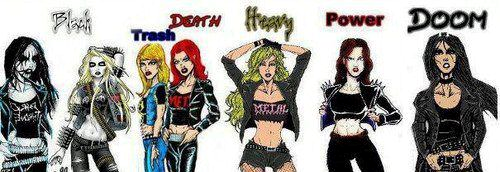
Now – I’ve heard the argument that female metal artists have to (essentially) dress like sluts/groupies to get any attention in the metal community. I can think of a few women who break that mold…
As a matter of fact – the girls in Arch Enemy, Eluveitie, Unleash the Archers, Huntress, Kittie, Otep, The Agonist, Kittie (the list could go on all day) prove exactly the opposite is true. In fact, I would argue that women in metal have a LOT more credibility if they dress like fucking metalheads.
Now, let’s take a look at a few bands who perpetuate the “sex kitten” stereotype in metal.
Bands like “The Butcher Babies” and “In This Moment” certainly make it look like women have to use sex to make it big in the metal world. But, I would argue that they lack a certain degree of respect specifically because they do this. Sex obviously sells across genders, it’s kind of a mainstream “I win” button when it comes to selling albums. It’s what pop stars (and stars from every other mainstream genre) do, and quite frankly I consider the practice utter filth. So, this isn’t a problem with JUST metal – this is a problem in the record industry in general that translates to metal (as it relates to the music industry). So don’t blame fucking metal and it’s fanbase for a broader cultural problem.
I can’t think of a single metalhead male I’ve ever met who thinks that these acts (Butcher Babies, In This Moment, etc) are anything even close to credible – and they most likely wouldn’t buy their music. Not because they’re women in metal, because they’re women who are degrading themselves in metal to make a few bucks. If they had the musical talent necessary to make it in metal, skimpy clothing wouldn’t even be on the table. There’s a reason Doro is a fucking legend in metal – because she didn’t compromise herself.
So, we can kind of see a pattern here – the only female metalheads who use sex appeal over talent are the more mainstream bands. And I have a big problem with this. Not because I dislike the thought of women using any tools at their disposal to make it big – that’s fucking awesome. Not because I don’t like scantily clad women – because I fucking love that shit. I have a problem with it because mainstream metal is the gateway for people to get into some of the harder, underground stuff. And if the first thing girls see is a bunch of scantily clad female metal artists, they’re going think this is the way they need to dress when they go to a metal show.
Why it’s Good to Pay Attention to What You’re Wearing at a Metal Show
Now, there’s nothing wrong with women wearing scant clothing at a show. But, it’s good to keep in mind that there’s already a culture of women who go to shows in sexy clothing. They’re called groupies. And within groupie culture, dressing in a certain way signals that these girls are there specifically to try and have sex with the band. Not in a “they’re being taken advantage of” or a “this is the only way women can participate in the culture” sort of way. In an empowering, these girls are exactly where they want to be doing exactly what they want to do sort of way.
However, this does present a cultural problem. Girls that emulate a mainstream metal female (and decide to dress in a promiscuous fashion) are probably going to be mistaken as a groupie. Not because all men are pigs, but because their fellow females have participated in creating a groupie culture within metal and hard rock. A culture that’s so ingrained that there are typically three types of backstage passes – one for people who have paid, one for women who have performed sexual favors for the road crew, and one for women who have been selected to come backstage and have a chance at performing sexual favors for the band(s).
This isn’t based on any science – just simple observation. A very liberal estimate puts the ratio of guys to girls at a metal show at roughly 9/1. Meaning at least 90% of the crowd in at any given metal show is male. And out of the 10% that’s female, you’ve got enough groupies and tag-along girlfriends who don’t even really listen to metal where a certain amount of stereotyping is just going to happen.
Now, these numbers are changing (thank god, a few women certainly bring a breath of fresh air into the sausage party that is a metal show) – but the only real way to get rid of these negative stereotypes is for girls to go to metal shows. Not just as a tag-along girlfriend (there’s nothing wrong with this, but there’s a reason that stereotype exists), and not just to dress promiscuously with the hopes of hooking up with either the band or someone in the audience. The more genuine female metalheads there are at shows, the more that stereotype will disappear.
cover of “I’m With the Band: Confessions of a Groupie”
And when I say “genuine female metalheads”, I mean girls who are fans of the music, participate in the culture, and are not there for the express purpose of finding a sexual partner. And unless you’re willing to dis-empower groupies, this is probably going to always be the case. Can groupies be genuine metal fans? Sure. Will they ever be viewed as anything other than a sex object by the majority of metal fans? Probably not – seeing as sex is part of the base on Maslow’s Hierarchy of needs, you’re never going to be able to compete with several millions years of instinct. So, for the same reason the guys in Magic Mike will never be viewed for their acting talent – groupies and those who dress like groupies will always be initially viewed as sex objects. I’m not trying to say men are blameless victims of evolution or something – but that’s pretty much the way humans (male and female) are wired.
Visual cues aren’t limited to groupie dress codes – when I talk about something like “unwritten rules of metal“, I’m referring to cultural norms, many of which are based on visual cues. Metal Culture relies heavily on visual cues 1) because humans are predominantly visual creatures and 2) because in many areas of the world metal is shunned. The easiest and fastest way to communicate your love of a particular band, or participation in metal culture generally, is through (what is commonly referred to as) ‘the uniform’.
Side note – this is why I make a big deal out of mainstream culture co-opting the metal uniform over the past few years. It’s sending false signals – there’s nothing quite as annoying as walking up to someone in a metal shirt and finding out they don’t listen to the band/album displayed on the shirt.
Dealing with Metal “Gatekeepers”
Women have a legitimate gripe in this area, and I’m 100% against someone coming up to another person at a show and quizzing them as a way of forcing them to display their “metal credibility”. And girls do get this a lot more than guys. But it’s not exclusively a female problem – in fact it’s such a widespread phenomenon that Brien Posehn made a music video/song about it…
So, even if we get to a point where this doesn’t happen to women more frequently than men, it’s still going to happen. Because assholes are everywhere.
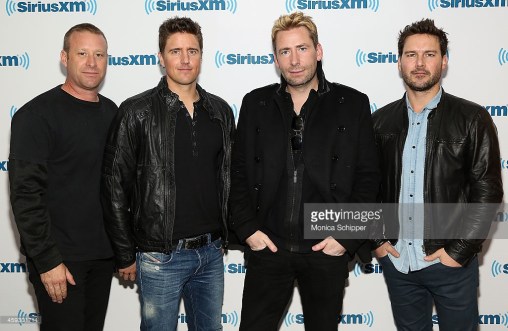
The more you think about it – the more it makes sense. Deafheaven is the Nickelback of Black Metal.
Both bands capitalize on “post-music” style movements; Nickelback is considered “post-grunge” while Deafheaven is making waves with the moniker “post-black metal”. Both bands play bland, watered down versions of the genres they emulate – making a “safe” version of transgressive music completely devoid of substance.
N-I-C-K-E-L-B-A-C-K is a 10 letter conjunction of two words from the English language that do not go together.
D-E-A-F-H-E-A-V-E-N is also a 10 letter conjunction of two words from the English language that do not go together.
Nickelback got their name from their lead singer’s first (botched) attempt to buy marijuana (they’ve since recanted this and go by some lame story about working in a coffee shop), and the guys in Deafheaven are the type of people you would charge $50 a gram. Nickelback released this information because they want to seem slightly transgressive while still approachable – which a botched drug deal does quite nicely. Deafheaven’s lead singer tries to give the impression that he’s stoned in every fucking interview for the same reason, a safe version of transgressive behavior.
Both of them have shitty publicists who insist on having them take “edgy” pictures (presumably to endear them to the hard rock/metal fanbases they’re supposed to appeal to)
“Make sure one of you is wearing denim”
Both bands have legions of haters (myself included). I think this is the part where I mention that nobody fucking cares what you listen to, as long as you call a spade a spade. Both of these bands are watered down, palatable versions of what was edgy 10 years before them.
Also, apparently one brave man before me made this connection – and this song is the result.
(these photos were the result of a google search – all credit goes to their original owners)
9 years ago this month (August 24th, 2007), a terrible tragedy in England resonated throughout the sub-cultural (and mainstream) communities around the world.
Sophie Lancaster and her boyfriend (Robert Maltby) were targeted by a group of thugs and brutally attacked. There was no provocation – they were chosen because of the way they dressed (as I understand it they were part of the English Goth community).
Although Goths and Metalheads are separate and distinct cultures, there is a good deal of crossover between them (as there is with a lot of sub-cultures). Enough crossover, in fact, that both the young men committing the criminal act and the witness who called the paramedics referred to them (among other things) as “moshers” (a pejorative term to refer to goths, metalheads, and other similar looking subscribers to sub-cultures in England, as I understand it).
And this wasn’t an isolated incident. I’m not saying anything sensationalist here – heavy metal and other subcultures aren’t under constant attack. But when you participate in any subculture/counter culture, it’s good to remember that there’s going to be a broad spectrum of reaction from the mainstream cultures (and other subcultures, for that matter) that’s going to include (but isn’t limited to) physical retaliation and violence.
So, while I have absolutely no idea whether or not Sophie Lancaster and her boyfriend actually listened to heavy metal or were part of the subculture – it’s a moot point. To someone who comes from a place outside of these cultures – they’re all one and the same. Ben Moores (a teenage metalhead) was attacked in a similar manner to Sophie 5 years later.
An American Perspective to Illustrate a Greater Point
And I have to admit, as an American Metalhead my knowledge is inherently biased towards my own experience and those of my peers. For example – I’m much more familiar with the cultural persecution of metalheads in America from the Satanic Panic of the 1980’s and early 1990’s and the subsequent cultural fallout.
Judas Preist and Ozzy Osbourne were both put on trial after young men who were fans of their music committed suicide. Christian youth behavioral modification camps capitalized on the satanic panic to “de-metalize” or “de-punk” rebellious youth. American police were trained to recognize and discriminate against metalheads. Censorship as a part of a multi-faceted attack on heavy metal that includes religious moral and political concerns from the dominant culture is nothing new. (Sound of the Beast, by Ian Christe, chapter 17)
Three teenage boys (dubbed the West Memphis Three) were scapegoated in a brutal murder case of three young boys on circumstantial evidence and held for 18 years. Even after they were freed (they were obviously innocent – this was the subject of several documentaries) – they had to agree to a plea deal where the state admitted no wrongdoing.
And, although marginalized, the demonization of heavy metal and it’s followers by the church continues in the United States to this day.
What Does this all Mean?
When a mainstream/dominant culture demonizes or vilifies a smaller sub-group on a large-scale/macro level, there tend to be individual manifestations of this within the interactions between members of those cultures on a micro/individual level.
If the church and the government in the United States had not brought mainstream culture to a state of panic concerning heavy metal in the United States (elected representatives publicly speaking against the music, media demonizing fans and musicians alike, congressional hearings spurred by the PMRC resulting in the censorship and subsequent economic sanctions that occurred as a result, etc), there most likely wouldn’t have been such a tendency towards blaming heavy metal for societal ills on an individual/micro level.
Applying this to the situation in England, I’m guessing that greater cultural norms had a significant impact on the social landscape of the country. Considering that the pejorative term “mosher” even exists to describe anyone who is a member of the subcultures being discussed in this article – I’d say that’s a pretty safe bet. The negative mainstream cultural connotations attributed to metalheads and goths (and others) can be seen as both an indirect and a direct cause of these brutal hate crimes. This sort of hatred didn’t come out of thin air – it’s a logical conclusion that a similar societal pattern existed in England to the one in the United States that led to where we are today.
So, the legacy of Sophie Lancaster is best exemplified through the Sophie Lancaster Foundation – which is focused on creating respect for and understanding of subcultures within communities.
Moving Forward
I would argue that there is a responsibility on behalf of the global community of such subcultures (metalheads included) to not only remember such horrible events, but to recognize societal patterns that have proven historically to lead to this sort of violence and intolerance.
Because it’s not limited to England and the United States (or Christianity) – I recently wrote a piece dealing with a situation in Romania where the church has caused a stir in the local community.
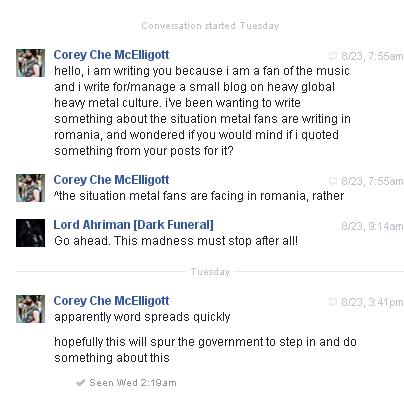
After receiving the blessing (sic) of Lord Ahriman of Dark Funeral to use some of what he was saying/reporting on in the area, I wrote a piece detailing how the a Russian Orthodox Priest had petitioned the local government in protest of Dark Funeral’s recent concert in the area. the government, in turn, issued a vocal statement that they would allow the priest to decide who did or did not play at public venues in the area.
The problem with this is that in similar instances across the globe where a particularly fundamentalist religious population enlists and is granted government aide to strip a group of citizens of their rights leads to a societal marginalization that can (and has) led to individual incidents of violence against people of that particular group. And metal culture has been proven to be particularly susceptible to this around the world.
Whether it’s in Africa, South America, Latin America, the US, Europe, Russia, China, Malaysia, India, or anywhere else on the globe – it’s good for people to be aware that this sort of thing can and does happen.
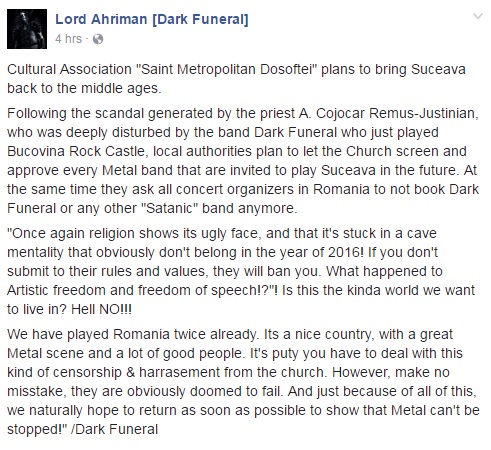
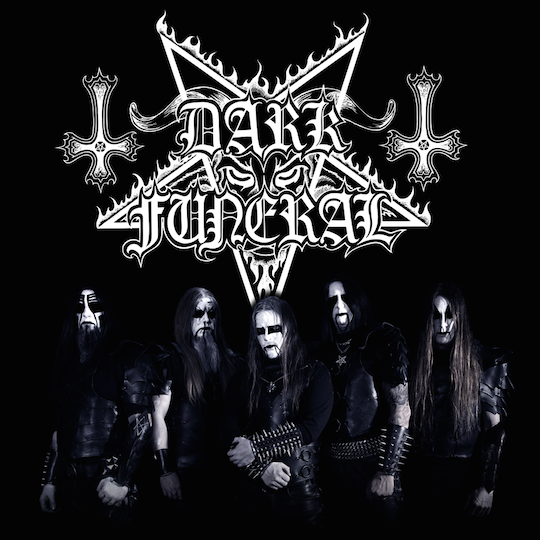
Following a show by the band Dark Funeral at Rock Castle, Romania (a country that upholds the controversial figure Vlad the Impaler as a savior of Western civilization) has recently announced that all future metal shows in the area will have to be approved by the orthodox church. How ironic.
The first I heard of this situation was through the facebook posts of Lord Ahriman and his band Dark Funeral.
I’ll tell you where they are. While parts of the world are working hand in hand with the church to ban metal music and oppress thousands of metal fans – sites like Metal Injection, MetalSucks, Blabbermouth, Pitchfork, Lambgoat, and the like are busy promoting a band that calls itself black metal while spewing a manifesto that goes completely against the spirit of the genre. They’re literally promoting a band that would see black metal reduced to a socially acceptable construct, free of the transgression inherent in the DNA of the genre.
Thank god the members of Dark Funeral have the fucking balls to stand up for transgressive art and freedom of speech and expression in an area that obviously needs it.
Both the Romanian government and metal media should be ashamed of themselves for their conduct (or lack thereof) towards this situation.
EDIT:
A note to the Romanian people,
I am not writing this in any way, shape, or form to insult the Romanians as a whole. The purpose of this article is to shed some light on a disturbing situation that is unfolding in your country.
The reaction was to grant him the ability to decide which bands are allowed to play in the town. This is in violation to several sections of the Romanian Constitution.
It violated article 15 (All citizens enjoy the rights and freedoms granted to them by the Constitution and other laws, and have the duties laid down thereby) by giving the priest and his congregation the freedom to take away the freedom of the 10,000 concert attendees.
Article 15
(1) All citizens enjoy the rights and freedoms granted to them by the Constitution and other laws, and have the duties laid down thereby.
It violated Article 16 (Citizens are equal before the law and public authorities, without any privilege or discrimination) in the same manner as article 15.
Article 16
(1) Citizens are equal before the law and public authorities, without any privilege or discrimination.
(2) No one is above the law.
It violated Article 29 almost in it’s entirety by forcing the religious ideals of one group on the masses.
Article 29
(1) Freedom of thought, opinion, and religious beliefs shall not be restricted in any form whatsoever. No one shall be compelled to embrace an opinion or religion contrary to his own convictions.
(2) Freedom of conscience is guaranteed; it must be manifested in a spirit of tolerance and mutual respect.
(3) All religions shall be free and organized in accordance with their own statutes, under the terms laid down by law.
(4) Any forms, means, acts or actions of religious enmity shall be prohibited in the relationships among the cults.
(5) Religious cults shall be autonomous from the State and shall enjoy support from it, including the facilitation of religious assistance in the army, in hospitals, prisons, homes and orphanages.
(6) Parents or legal tutors have the right to ensure, in accordance with their own convictions, the education of the minor children whose responsibility devolves on them)
It violated article 30 by allowing censorship of the freedom of expression of the 10,000 concert attendees:
Article 30
(1) Freedom of expression of thoughts, opinions, or beliefs, and freedom of any creation, by words, in writing, in pictures, by sounds or other means of communication in public are inviolable.
(2) Any censorship shall be prohibited.
(3) Freedom of the press also involves the free setting up of publications.
(4) No publication shall be suppressed.
(5) The law may impose upon the mass media the obligation to make public their financing source.
(6) Freedom of expression shall not be prejudicial to the dignity, honour, privacy of a person, and to the right to one’s own image.
(7) Any defamation of the country and the nation, any instigation to a war of aggression, to national, racial, class or religious hatred, any incitement to discrimination, territorial separatism, or public violence, as well as any obscene conduct contrary to morality shall be prohibited by law.
(8) Civil liability for any information or creation made public falls upon the publisher or producer, the author, the producer of the artistic performance, the owner of the copying facilities, radio or television station, under the terms laid down by law. Indictable offences of the press shall be established by law.
It restricts access to culture guaranteed under article 33…
Article 33
(1) The access to culture is guaranteed under the law.
(2) A person’s freedom to develop his/her spirituality and to get access to the values of national and universal culture shall not be limited.
(3) The State must make sure that spiritual identity is preserved, national culture is supported, arts are stimulated, cultural legacy is protected and preserved, contemporary creativity is developed, and Romania’s cultural and artistic values are promoted throughout the world.
It opens the door to economic restrictions on local metal bands not approved by the priest, and allows for the possibility of future violations of your citizen’s rights by limiting their access to the local economy in violation of article 45.
Article 45
Free access of persons to an economic activity, free enterprise, and their exercise under the law shall be guaranteed.
And the town council members are in violation of articles 54 and 57 through this act…
Article 54
(2) Citizens holding public offices, as well as the military are liable for the loyal fulfilment of the obligations they are bound to, and shall, for this purpose, take the oath as requested by law.
Article 57
Romanian citizens, foreign citizens, and stateless persons shall exercise their constitutional rights and freedoms in good faith, without any infringement of the rights and liberties of others.
So, while I might not live in Romania – the internet allows access to your laws. And your constitution is obviously based on the United States constitution (which I am very familiar with).
Maybe instead of getting angry at a person you will never meet over the internet you can focus your energies on protecting the rights of the 10,000 people who had multiple constitutional rights violations perpetrated against them to silence a dissenting priest and his congregation. Nothing about this action is OK.
When anyone acting under the authority of a government (even a public arts council who appropriates government funding) – they are acting for that government. The Suceava Council (elected officials) have responded to a letter from a pastor – stating they will allow him to have some say in who does and does not get to play in the country. So, when I say “Romanian Government decrees” that is exactly what I mean, and it is 100% true. Because, until your government says otherwise – this is the will of the Romanian government and people. You’re allowing the church to remove the rights of taxpayers, and to dictate the use of your tax dollars into cultural events that have to be approved by the church. That’s not democracy – that’s oligarchy.










 cover of “I’m With the Band: Confessions of a Groupie”






 metal stuff