I thought that with the upcoming release of Opeth’s album “Sorceress” it’d be a good time to reflect on the band. Past releases, current musical direction etc.
Also, the fact that Opeth are vagina magnets. I’m pretty sure it’s 100% scientific fact that every girl that likes metal likes Opeth (to be fair, pretty much everyone likes Opeth. I’d have an easier time listing off the metalheads I know who don’t like them). Seriously though, gaze upon this montage of women who like the band enough to get the logo tattooed on their bodies.
Never-mind the legions of female fans who aren’t as inclined to permanently etch it onto their skin.Now, there are any number of reasons why women might be so spellbound by this band.
Maybe it’s the fact that they’re a group with solid musicianship who can tastefully transition from full on guttural death metal to prog to “artsy-fartsy” avante garde material in a single song.
Maybe it’s the fact that they can do all of that, while still somehow remaining consistent in their work while still broadening their musical repertoire.
Or maybe, just maybe, the lead singer (Michael Akerfeldt) sold his soul to the devil. And instead of asking for fame and fortune (as is tradition in blues and rock music, or so the legend goes) – he asked for absolute power over female metalheads, without having to sell out in the process.
Artistic rendition of the crossroads transaction between the Devil and Michael Akerfeldt
It’s literally the only explanation that makes sense. Because traditionally, women tend to shy away from guttural vocals and full on brutal death metal (there are exceptions, of course). But women flock to this band like chicks in college do to that deuchebag who sits under a tree, plays four chords, and sings “really deep” love songs. And they don’t dress up like prissy, mainstream boy-bands pretending to play metal – these guys are the real McCoy.
In fact, with the exception of the last album (Pale Communion) Opeth has a solid lineup of albums that do not disappoint. And their recent signing to Nuclear Blast also signals they’re going to be moving in a much heavier direction – which I enjoy. If you’re new to Opeth or would like to check them out, the folks at reddit made a handy flowchart:
or just check out the latest single for the new album
In 2016, the internet has become such an integral part of global culture that it’s hard to imagine what life would be like without it. Social media, in particular, takes advantage of this massive global connection by helping people to communicate across the globe in real-time.But, strange as it seems, there was a time before the internet. People still communicated, albeit a lot more slowly.
So, how does this relate to metal culture? To understand how, first we should take a look at why metalheads would need to create a social network. In the 80’s and 90’s, heavy metal and it’s fans had a HUGE stigma attached to them (in some parts of the world, this stigma still exists). There was a large scale moral panic surrounding the music and it’s culture.
In the United States, for example, there was a growing wave of misinformation, political correctness, and organized opposition that threatened the very existence of metal. Police were trained to target metalheads based on the stereotypes propagated by the PC groups like the PMRC. Here are a few examples from a police training pamphlet called “Youth Subcultures”
By themselves, these images are humorous at best. But the descriptions accompanying the photos labeled all metal fans (and punks, the picture with the mohawk was sadly missing the label) as lowlifes with no motivation to do anything constructive, who’s only source of income was from theft and drug sales (also mentioning that most metalheads were avid drug users themselves).
Combined with metal being completely ignored by the music industry, disrespected by the media, metal shirts being banned from schools, young fans of the music being sent to counselors and camps for “de-metalizing”, and metal bands being put on public trial as scapegoats for youth tragedy – you’ve got a culture who’s very existence requires it to go “underground”.
And if you can’t find music you want in the normal media channels, where do you go? Simply put, you go to other fans of the music. But metal fans were few and far between – and spread all over the globe. There was no internet, no media, nothing – how did people find new metal that wasn’t a polished, formulaic mainstream parody of real music?
The answer, of course, was tape trading. Metal magazines were essentially the lifeblood of the culture. And the classified ads in these magazines allowed someone to advertise that they had new music for distribution, or to advertise their tastes. All you had to do was put in an ad with an example of a band you liked (and your mailing address), stating you were looking for more bands like them, and wait. People would send you music, mostly free of charge, that was in the same vein. Essentially it was a pen-pals with benefits sort of thing, and it completely cut the record industry out of the picture.
This is where the sub-genrefication of metal started, it was necessary to get people the music they wanted. This was also the time where the unwritten rules of metal started to solidify. These things are all manifestation of “sub-cultural space”, it’s how metalheads communicate aspects of metal culture to one another. It’s also when the metal “uniform” really came together and became a thing. The most important part of the uniform (wearing shirts of the bands you listen to) was a way to show solidarity with the culture, support for the bands (because they still get more from t-shirt sales than they ever did from albums), and personal musical taste to other people in the culture.
Fun fact – with the industry out of the picture metal was free to evolve without corporate influence. If it wasn’t for widespread persecution of metalheads (forcing them to go underground as a culture), you wouldn’t have Thrash, Death Metal, Grindcore, Hardcore Punk, Black Metal, or any of the extreme branches of the metal family tree that exist today.
In other words – this is when heavy metal completely broke off from rock and roll and became a distinct musical style with it’s own unique culture. Just like rock and roll broke off from the blues, metal severed it’s ties to rock music.
So, when you see an article bitching about how downloading music is killing the record industry – take it with a grain of salt. It’s killing the pop-machine entertainment industry for sure, but if you’re paying attention and capable of rational thought you can see even that claim is 100% bullshit. But as far as metal bands are concerned – sure, they’re seeing a drop in record sales. But record labels were pretty famous for signing metal bands to horrible long term contracts that gave away a lot of legal rights and fucked them over creatively for years. So they’re probably going to have to adopt a business model from heavy metal musicians, largely based on touring and merch sales. Soooo… the bands treated like dogshit by the major labels are now going to be their saving grace. Ironic much?
But I digress.
The outsider/taboo status assigned to metal by (and in) mainstream culture is what turned it into the cultural behemoth (pun intended) that it is today. File-sharing and social networking in the metal community is something that was happening for a full decade before the internet even existed. The transition to social networking and file-sharing websites was a natural one, metalheads simply digitized aspects of the culture that were already there.
That’s why metalheads still shit on Metallica on a regular basis. A shitty album or two can be overlooked – nobody bats 1000. But when you go after an evolutionary step of the very cultural mechanism that made you into what you are today (tape trading->file sharing, if you’re not following), you’re selling out completely. They sided with the same corporate entities that wouldn’t have given them the time of day a decade earlier.
Anyways – the only thing metalheads like more than metal is reading about how great metalheads are. So, there’s that. Enjoy.
Oh, if you liked this please feel free to join my facebook group metal stuff.
No, I’m not one of those guys who just calls everyone a poser. Yes, I think posers exist and can be a bit of a problem. Depends on the nature of the offense. More importantly, I think proper use of the term poser is an important mechanism within the subcultural space of heavy metal. Here’s why.
Introduction
So what/who is a poser? A version of the term exists in most big subcultures (at least the American ones) – and it’s generally used to refer to a person (or group) that adopts the look, language, and attitudes of a subculture without actually internalizing the values of the culture. In other words, it’s a person trying to be something they’re not to gain some sort of social status.
The practice of calling out posers is what’s known as a “defense against entryism” – it’s a way for the metal culture to police it’s own borders to prevent outside groups (like hipsters) from entering the culture and exercising undue influence to change social mechanisms and structure, and in so doing gain a large degree of socio-political power within that group. It has some negative consequences – but like “metal elitists” that everyone seems to be railing against, I think it has more to do with a misunderstanding of certain aspects and social mechanisms within metal culture.
With the current generation, (unlike prior generations) there is a movement of “scene tourists” who infiltrate and participate in various subcultures long enough to change them into something socially palatable to the general public – a good example of this would be the whole #gamergate/#metalgate fiasco. The two incidents happened right on top of each other, and the consequences of #gamergate are still being realized.
Case Study – Social Justice Warrior/Hipsters affecting Cultural Change
(Poser Type A)
To see what I’m talking about, let’s take a look at the “God of War” franchise. When it was released, it was quickly recognized as one of the greatest games of all time. It had violence, gore, the works. However, the most recent “God of War” installment shows the series protagonist, Kratos, is now living with his son. And instead of being the violent bloodbath that we all know and love, Kratos is now a father. The basic moral of the storyline is Kratos has to learn to deal with his aggression in a healthy way, and in so doing be a healthy role model for his son and make amends for past transgressions.
Seriously? Fucking seriously? SJW’s neutered one of the (arguably) greatest video game franchises of all time.
Nobody thought it could happen, but it did. One of these SJW’s who had been prominent during the whole #gamergate debacle was actually installed at a gaming convention and featured as a commentator/speaker. She didn’t even play video games, literally the only connection she had with video games was complaining about finding them offensive.
So what happened? A culture designed around an entertainment medium considered a transgressive art form (video games) had a large influx of people from a certain demographic group – Hipsters(from here on this will be referred to as the “hipster influx”). Now, not all hipsters are bad. And not all hipsters were trying to make video games politically correct. But everyone who was successfully part of the internal movement to self-censor video games was a hipster/SJW. The internal movement was the second part of the hipster influx.
Because in this instance, like every other instance of entryism, a social group that joins a larger group does so to gain social control of and power within the larger group. Gamers didn’t have a defense against entryism, and this was the result.
Case Study Discussion
(Poser Type A as They Relate to Metal Culture)
Like video game culture, Metal Culture is centered around transgressive art. Extreme Metal, in particular, crosses the line from “shocking” people (rock and roll territory) to “disturbing” people. Ironically, one of the (metal) bands most famous for starting the trend of visually and lyrically pushing the boundaries into truly disturbing territory was Carcass. This is ironic because the members of Carcass are all vegans/vegetarians, who were using metal as a springboard for their version of social justice ideals.
So, when SJW’s are railing against the disturbing aspects of extreme metal music – what they’re really doing is railing against the avenue paved by their predecessors to present a social justice issue through an acceptable avenue within metal culture. They understood the mechanics of the culture, and used them as an avenue of artistic expression with a valid socio-political message that was important to them. And they’re not alone, if I’m not mistaken Cattle Decapitation follows a similar vein.
What I’m trying to illustrate here is that there is a difference between participating in a culture (and using the various mechanics of it for personal expression) and infiltrating a culture (and trying to change the things you don’t like/understand about it).
Various entities have tried throughout history (unsuccessfully) to change video game culture from the outside in exactly the same way they tried to change metal culture. And the result was the same – both video games and albums with content deemed “offensive” to mainstream culture received warning labels. The intended purpose of these labels was to try and shame retailers from carrying said products – but the result was exactly the opposite. Those warning labels told consumers exactly what to buy – humans have an obsession with anything forbidden.
Now, we’ve seen a group practicing “entryism” and then using the social influence of membership within a group/culture to change the cultural landscape with video games – and the same cultural demographic that infiltrated gamer culture has a strong hold in metal culture. I’ve spoken about this previously, in an attempt to call out a writer for Metal Injection (Shayne Mathis) for his hipster shit. This is a direct example of entryism in metal culture – and the concept of a poser exists in metal cultural space specifically to prevent whiny shits like him from gaining prominence and turning metal into another bland, formulaic, mainstream medium.
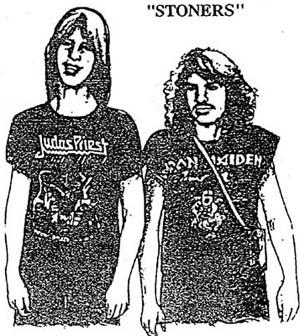
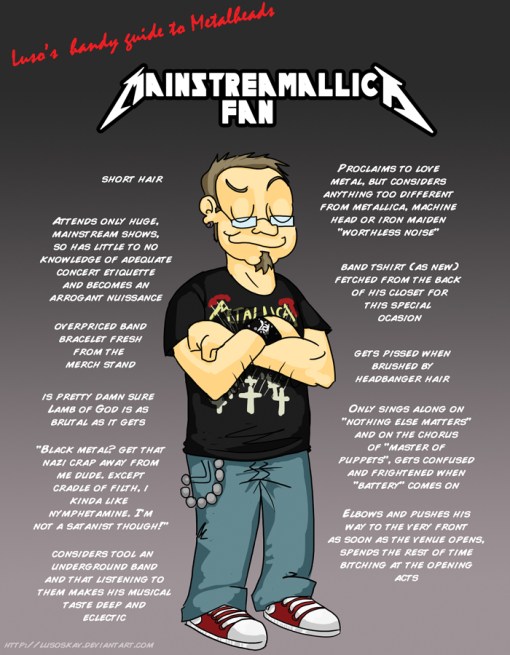
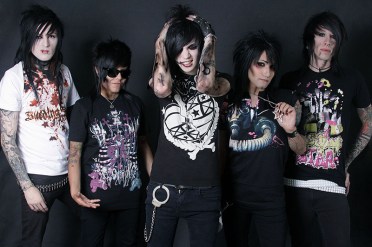
Visual representation of “Poser Type A”
Conclusion
(Poser Type A)
Shayne Mathis and his ilk are what I refer to as “Type A posers”. They’re pretending to be something they’re not and trying to use accumulated sub-cultural capital for the purpose of affecting social change where it isn’t needed or wanted. They are undesirables within metal culture because of the nature of their desire to impose a cultural overlay of self-imposed censorship within the metal community, and labeling them as what they are (posers) serves the function of marginalizing them to where they belong – the fringe/outside of the culture.
Case Study – Try-Hards
(Poser Type B)
This is a category I’m not entirely in agreement with, but in the interest of holism I’ll include it.
Example 1) Try-hard bands
Bands that adopt a position and posture themselves as something they’re not fall into the “try-hard” category with me. An example would be someone like Papa Roach.
Papa Roach present themselves as genuine, creative musicians within the mainstream genre known as Nu-Metal. Now, I understand the fact that it becomes increasingly difficult to write an original riff as time goes on – chances are someone else has written something close to it (if not that exact riff).
But when the riff of every single one of your hit singles is a direct ripoff of Iron Maiden, your authenticity comes into question.
(one example can be chalked up to coincidence, two of them is questionable but still possible, three strikes and you’re out)
And when every single one of your songs also follows a pop machine/record industry formula (A,B,A,B,C,B), you get another strike against you. Then, when you start apeing fashion trends like wearing makeup to appeal to the emo crowd it pushes me over the edge. Nevermind the fact that they decided to jump on the djent bandwagon. They’re just a bunch of trend-wore, try-hard posers.
Example 2) Try-hard fans
Yeek, this is one that gets overused a lot. In fact, I think the overuse of this mecanism is pretty much single-handedly responsible for the whole “posers v.s. elitists” thing that’s apparently a thing in metal nowadays.
Most commonly misused on people who a) have opposing taste in metal from the accuser or b) display a certain ignorance when it comes to the nuances of sub-genres – the typical response is to call the offender an elitist. In this case both parties are wrong, if you’re interested in reading why I suggest checking out my articles dealing with the difference between elitists and assholes and why sub-genres are a good thing (but assholes ruin them for people).
It’s interesting to note here that a person using the term poser to knock another person’s taste in metal is, in fact, the poser in the equation 99.99% of the time. They’re taking a position to try and look like something they’re not, and that is the fucking definition.
The exception to this rule is best displayed by example; You’re speaking with someone who is making blatant misstatements such as “death metal is my life” or “I only listen to hardcore/brutal/death metal”. When asked to list examples, scene/emo bands (asking alexandria, blackveil brides, blood on the dance floor, etc) are generally listed off. In this case, correcting the record might hurt this person’s feelings – you’re blowing up their spot and calling them on bullshit, so of course they’re going to be a little put off by it. But, they were presenting themselves as something they weren’t.
This isn’t a case of elitism, calling out someone for being a poser when they’re genuinely being a poser is calling a spade a spade. I can’t believe I have to actually say this, it always just seemed like something that would be common knowledge. I’ve seen a lot of blogs/etc stating that posers don’t even exist.
A guy who I enjoy and even agree with quite a bit (coverkillnation) recently made a video that more or less stated (at about 5:00 into the video) that posers don’t even exist. I’ll admit, he makes some good points, and I understand why he’s saying it – because of the blatant overuse and misuse of the term. I happen to agree with the spirit of everything he’s saying, but disagree with how he presented some of his points. Posers certainly do exist, but 99.99% of the time it’s used incorrectly.
There’s no shame in having musical taste (diverse or otherwise), but lying about your musical taste in the hopes that people will like you more is frowned upon in pretty much every genre of music – it’s just an exaggerated frown in metal culture. And it earns you the label of poser.
The only other example of a try-hard poser I can think of is summed up much better by Infidel Amsterdam here:
Case Study Discussion
(Poser Type B/Try-Hards)
Like I mentioned earlier, this is an instance where the term/cultural mechanism of poser gets overused and abused. And the coverkillnation video I referenced earlier touches on a lot of those misuses of the term as well as I could, I highly recommend checking out his channel.
I feel like I gave two solid examples where the “try-hard” category of poser is not only applicable, it’s correct (and serves it’s intended function as a cultural mechanism). Labeling a band like Papa Roach (that probably should have been sued for copyright infringement and obviously changes social trends more quickly than they do clothing) as a poser band isn’t something I would apologize for – in fact I would love to hear an argument to the contrary. Mostly because I can’t think of one.
And calling people who pretend they listen to bands or genres (to try and gain positive social attention and credibility within a culture) posers might hurt their delicate feelings, but it isn’t wrong. Likewise, in the case of Infidel Amsterdam’s video, a person who adopts the look and language of a metalhead but drops the whole thing later on and writes it off as a phase is totally a poser – and has earned that label.
Conclusion (Poser Type B)
The situations/people that fall under this category of poser are ones that I would use with relative caution. Like I mentioned before, the tendency towards misuse or abuse of the term is very high. And a lot of assholes like to use it as an excuse to make another person feel inferior because that person doesn’t share exact musical preferences. At the same time, this term does serve a specific (if misunderstood/misused) purpose to the greater culture.
However, the name “try-hard” is a bit misleading. Because there’s nothing wrong with trying to learn more and participate in any culture or activity you’re interested in. Quite the opposite, I think most people would agree that’s a pretty good quality to have. And the ones who disagree are just assholes.
Case Study (Poser Type C)
The last type of poser is probably the most recognizable, accurate, and most difficult to defend.
A few months ago I was at a store in the local mall and I saw a guy wearing a Megadeth shirt. I complimented him on it, and asked if he had listened to Dystopia yet. He looked confused, so I told him it was the most recent Megadeth album. He informed me that he didn’t listen to Megadeth, he just liked the way the shirt looked.
What the actual fuck.
I tried not to be rude, I just said “Oh, sorry” and walked away.
Case Study Discussion (Poser Type C)
Seriously though, did I miss something? I mean, there are always going to be people in every subculture that try to be something that they’re not to fit in. I feel more sorry for them than anything – but I think it’s still safe to call a spade a spade in this instance. It’s false advertisement, and I really can’t think of a place in society where that’s considered a good thing.
However, I do have a big problem with people who just want to look like a metalhead because it makes them look edgy or cool. I can’t believe that’s even a thing. That’s why I went to the trouble of going back and finding every instance of it I could and documenting the phenomenon. I’m not saying my knowledge of the topic is 100% perfect, and I might have missed a few things – but it does display a pattern in popular society where people are picking up pieces of the metal “uniform” and adopting them as an edgy fashion trend.
This is probably the most important purpose of the term “poser”. Nobody wants the label – and in learning that you don’t wear a shirt of a band you don’t listen to, you learn an important rule that applies to every genre of music. You only wear a shirt from a band you listen to.
When you’re wearing a band shirt, you’re non-verbally advertising your musical tastes. The purpose of wearing a band shirt (beyond showing support for a band) is so that any fan of the band who sees you wearing it has the opportunity to compliment it or strike up a conversation. If you’re a metalhead, you might have noticed you don’t get a lot of chances to talk with people about music in everyday life. Talking about metal on the internet is one thing, but hearing someone yell SLAYER randomly in public when they see your shirt is a horse of an entirely different color.
Conclusion (Poser Type C)
I really can’t think of an argument within metal culture or outside of it where you would call someone who does this anything besides a poser.
So what does all of this mean? If you’re not a metalhead, nothing. Within the metal cultural sphere, I think it means that it’s important to recognize and be able to differentiate between assholes and people who are performing a role in the community that’s served it pretty well for at least 30 years.
The term poser and the social implication of it serves a role critical to the maintenance and function of the culture in at least three different areas – it maintains a continuity of culture (with type a posers), it serves as a reality check for members and a ready way to recognize cultural outsiders who are more concerned with exploiting social trends for financial gain (type b), and most importantly it conveys the values and norms/practices of the culture (type c).
Now Raven (who isn’t alone in this opinion) contends that the “metal” as represented by bands like Linkin Park, Disturbed, Five Finger Death Punch, Slipknot, and the like isn’t even metal. There are elements of this statement that I sort of agree with, but I have to respectfully disagree with the overall statement.
The reason I disagree is because I think there’s a more accurate way to look at the situation. Metal has two faces, a public (or mainstream) face and a private (or underground) face. This isn’t some new or revolutionary observation – it’s an argument that’s been going on since the genre fractured. It’s been covered by every single major metal sociologist; Deena Weinsteen (Heavy Metal: The Music and Its Culture and Heavy Metal: A Cultural Sociology), Robert Walser (Running With the Devil: Power, Gender, and Madness in Heavy Metal Music), Ian Christe (Sound of the Beast: The Complete Headbanging History of Heavy Metal), Malcolm Dome (The bible of Heavy Metal: Encyclopaedia Metallica, Thrash Metal), Keith Kahn-Harris (Extreme Metal: Music and Culture on the Edge), Sam Dunn (Metal: A Headbanger’s journey, Global Metal, Metal Evolution, Banger Films) in some form or another.
The reason that metal culture as a whole can have these opposing factions is because it isn’t a single, unified culture. It’s what’s commonly referred to as a bricolage culture – a hodgepodge collection of distinct groups and scenes with a unifying theme (metal) that form a complete culture.
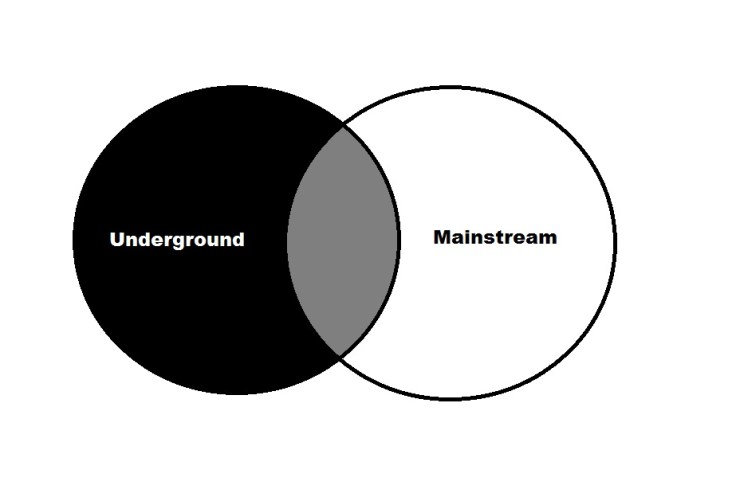
For the purpose of this article, metal can be viewed like this;
Both sides have their positive and negative aspects. An underground band has the ability to gain a significant amount of credibility within the scene, at the expense of a smaller fanbase. A mainstream band has the monetary advantage, as mainstream viability means you’re reaching a broader audience. However, the price of mainstream popularity comes at the expense of a band’s credibility within the broader metal scene. And in metal, credibility is everything.
Bands are not stuck in a single category, movement between these areas is fluid – but with a catch. They can only move in one direction. A mainstream band cannot under any circumstances move back to the underground. An underground band, however, has the ability at pretty much any point in time to move to the mainstream. There’s even a (often overused) term for when a band moves into mainstream territory – selling out.
To become popular, most underground bands tend to try and stay in the grey area between mainstream and underground – maximizing the size of their audience while sacrificing as little credibility as possible.
So, it’s not really a dichotomy. It’s more of a “collage spectrum” that’s defined by the polar extremes.
Cultural fracture point – when metal gained two identities
When metal actually fractured into these two distinct categories (mainstream and underground) is up for debate. The divide became recognizable when Thrash (underground) and Glam (mainstream) arose as two distinct entities in the 80’s. That’s when we got terms like “lite metal“, which were used by members of the underground community to refer to their mainstream counterparts.
Arguably, the divide between mainstream and underground metal goes back another generation. When Def Leppard refused to be associated with/included in the NWOBHM, band members stated it was because they wanted their band to be associated with the greater “hard rock” category (as opposed to the niche underground genre that NWOBHM was at the time). And if you look at the first wave of mainstream metal (Glam), you can clearly see it’s roots in the styles of both Def Leppard and Led Zeppelin.
I think it’s worth mentioning that bands that existed within the cultural sphere of heavy metal before the mainstream/underground fracture are immune to this classification. It was created to differentiate the new bands, and any attempt to use them as anything else would be inaccurate.
Metal in the Mainstream
It all started with Hair Metal/Glam in the 80’s, which combined metal with popular hard rock from the time period. And as with anything mainstream, hair metal was beholden to corporate influence. So when the music industry had completely exhausted the genre (through formulaic “clone” bands and over-promotion), they moved on to “the next big thing” and declared metal dead. So, in the eyes of mainstream culture – metal had died. And in it’s place was a new mainstream genre – Grunge.
Grunge was effectively the anti-thesis of hair metal. It’s combination of metal and alternative rock pushed apathy and mediocrity as a counterpoint to hair metal’s excitement and over the top excess.
In fact, the only thing I can think of that Glam and Grunge have in common is the incredible amount of heroin band members from both genres consumed. Which, in it’s own way, helped define their shelf lives. I guess every cloud has a silver lining.
Then in the mid 90’s a new mainstream contender entered the arena – Nu Metal. Combining rap with elements of alt-rock/grunge and heavy, down tuned riff oriented metal on (typically) seven string guitars. While musically much more aggressive and exciting than it’s predecessor, it remained a relatively simple and easily digestible form of metal that was fit for mass consumption and easily duplicated by the record industry.
The mid 2000’s saw the fall of Nu Metal and the rise of Metalcore. Taking the already established hardcore/metal fusion that had been mixing with the Gothenburg brand of Melodic Death Metal (and adding the signature whiney Emo vocals), metalcore took the mainstream by storm.
Nowadays, as metalcore is waning in popularity, bands like Periphery and Liturgy are crossing one of underground metal’s more extreme sub-genres (Black Metal) and mixing it with apathetic, “self absorbed posing as introspective” hipster Indie rock genres like Shoegaze to create the musical abomination known as blackgaze. Combined with the large number of bands aping djent and mixing it with mainstream influences, it’s only a matter of time until we see the next big trend in popular metal.
I’m not sure where the fuck Five Finger Death Punch fits into all this, probably the fact that they mixed the groove metal of Pantera with mainstream hard rock. However you want to categorize them, calling them anything other than mainstream metal is a disservice to the intelligence of both the speaker and the listener.
Metal in the Underground
(This is where the magic happens)
Recently Thrash, Death, and Black metal have all been encompassed into an overarching umbrella term – Extreme metal. A fair description, as they all tend towards extremity. I like the term, and it puts all the bands in a proper context – all extreme metal is in some way shape or form a derivative of the thrash metal movement of the 80’s, although bands such as Celtic Frost, Bathory, and Venom (generally dubbed the “first wave” of black metal) also serve as the genre’s precursors. I’m pretty sure Keith Kahn-Harris does a better job explaining it all in his book. Also, Sam Dunn did an excellent crowdfunded “lost episode” of his series Metal: Evolution dealing with the subject.
Exceptions
While metal has been, since it’s inception, a predominantly underground phenomenon, when referring to “underground metal” people are generally talking about thrash and it’s derivatives. Like I mentioned earlier, this split happened after bands like Sabbath or Maiden hit the radar, so while they would fit the mold for underground metal – they also (by standing the test of time) fit into the mainstream metal category. They’re neither and they’re both.
It is interesting to note that in the vein of these classic bands, metal in the underground follows a generational musical progression that’s the only consistent pattern in heavy metal since it’s inception – the new stuff is always heavier. It’s harder, it’s faster, it’s more distorted, and it’s progressively more socially transgressive. Sam Dunn touched on this in his first movie, Headbanger’s Journey – new generations of bands continue to strive to sound heavier than the generation before them.
Conclusions
In context, Raven’s assertion that the “mainstream” metal bands aren’t metal at all is technically true. In every incarnation, the thing mainstream metal bands all have in common is that they dilute heavy metal by mixing it with a more “palatable” style of music. With hair metal, it was diluted with hard rock (including rock ballads, ugh). Grunge watered the heaviness down with popular college alternative rock. Nu Metal did it with rap and alt rock. Metalcore did it with emo. And modern day hipster bands do it with Indie rock (Indie meaning hipster/millennial co-opted melancholy, boring, crap rock – not indie as in independent… there’s a huge independent streak in underground metal).
Saying these mainstream bands “aren’t real metal” isn’t (generally) meant as an insult, it’s an attempt to keep accuracy in the conversation. Metal is generally viewed as genealogical, so an example of that ilk might bring some clarity.
If you breed a horse and a donkey together – the resulting creature is called a mule. It’s not a horse, and it’s not a donkey. The two animals are closely related and branch from the same evolutionary family, but distinct enough to warrant a different name for each distinct species. A mule, the resulting offspring from the union of the species, cannot accurately be called a horse or a donkey because it is equal parts horse and donkey. However if the mule proves fertile (most often they’re not) and is bred with another horse, the resulting offspring will be categorized as a horse.
Substitute “metal” for “horse”, and “rock” for “donkey”, and you essentially have the entire argument against “mainstream metal” being considered part of the metal family tree (instead being relegated back an evolutionary step to the “hard rock” category). If any of the mainstream/popular genres spawn/influence new music by being crossed back with metal genres – the result is considered to be part of the metal tree.
I always figured this sort of knowledge was just a given, but apparently it’s not. the massive amount of butthurt expressed online by hipsters and others outside the metal community when they’re improper use of terminology is corrected just seems to be part of the social landscape.
This duality within the genre is also the source of endless frustration expressed in memes like this gem…
Now, as someone who was a pretty big fan of Nu Metal, I might be a tad biased in my opinion. I prefer a touch of holism with my definition of metal – while I’m predominantly a fan of the underground/extreme branch of the metal family tree, I refuse to discount the importance of mainstream metal bands to the culture.
First and foremost, they represent the social gateway into greater metal culture. Nobody starts off listening to Extreme Metal, taste progression in metal is generally a process – and “Gateway Metal” bands generally kick-start the process. They also represent the metal community to the mainstream in other respects.
When the PMRC kickstarted congressional hearings on heavy metal in the 80’s, they completely neglected to mention underground bands. It was Dee Snider of Twisted Sister who went and spoke for the genre, and completely exposed the entire debacle for what it was – a modern day witch hunt. Slipknot and Marilyn Manson (as well as Ozzy, Preist, and Maiden – but if you’ve been reading they’re excluded from this classification as they encompass both mainstream and underground characteristics) were publicly scapegoated as the reason behind public controversies. From grave robberies to school shootings, as soon as heavy metal is found in the mix it’s automatically considered the cause.
So, these aren’t just the people who recruit new member to the metal cause, they’re the ones who defend it in the public eye. They also transmit the norms of metal culture to new recruits. Considering these critical roles mainstream metal bands play in the overall culture, I don’t believe it is accurate to call them anything other than metal.
This doesn’t mean I won’t call a spade a spade, mainstream metal is gimmicky as hell and has a lot of elements of mainstream culture I generally try to avoid. But you can like, or at very least appreciate, a band and the role they play in overall culture without dismissing them because they A) fill a different cultural niche than underground bands and B) don’t conform to a minimalist definition of metal.
Shameless plug, if you like what you read feel free to join my metal facebook group Metal Stuff.
At first glance, that seems pretty cool. The names kinda lame, but at least it seems to be a rock/metal oriented movie. But then, looking at the cast, I noticed it’s starring the lead singer of the Blackveil Brides, as well as a member of Asking Alexandria.
What the actual fuck?!?
When the Summer Slaughter tour started out, it was a force to be reckoned with. They’re continually billed as “the most extreme tour of the year” and have been pretty famously advertised as catering to fans of “extreme metal”. And for the first year of their existence, this was true.
Then came the slow descent – the lineup steadily got worse every year. I would argue that a big portion of this is due to the participation of Sumerian Records. Initially the label brought diversity to the bill, which isn’t a bad thing. It’s what you’re supposed to have at a festival. But I started noticing a pattern – a few big names in death metal were being used to add star-power to a tour that progressively started catering to an indie label (like independent startup label, not to be confused with shitty millennial/hipster Indie rock).
I’m trying to think of another tour that changed their business model to cater to an indie label with a shitty roster.
Oh wait, now I remember. The Mayhem festival.
I’ll take you one further – Mayhem started to go downhill the same year that Sumerian Records got their own stage (2013). The lineup that year was actually pretty awesome (on par with how awesome this years Summer Slaughter lineup is, considering the formats of the festivals). Post 2013, these changes cause the decline I’ve been referring to. Mayhem went so far downhill, in fact, that it literally dampened the concert draw of headliners like Slayer.
Slayer had played the same venues as Mayhem the previous year, selling out concerts. Strangely, Mayhem didn’t. But why?
Kerry King said it best:
“Do I know this tour wasn’t booked correctly? Absolutely I know this tour wasn’t booked correctly. Gary Holt made the comment that usually there’s the Main Stage, a second stage, a third stage, and then that piece of shit record stage…now what they’re calling a second stage is at best a fourth stage and they’re wondering why people aren’t showing up.
In case you’re not familiar with the whole Mayhem festival debacle, I’ll save you the trouble of a google search. It completely imploded and dissolved.
So let’s recap for a second.
Mayhem festival started out with huge names, as a rather diverse metal festival. They had some heavy hitters, and then filled the roster with up-and-comers from independent record labels that catered to scenes that weren’t even fully accepted in the metal community (This is a good thing, it’s how we keep the music going – but there’s a point, I promise. Bear with me). Slowly they allowed said the independent record label to change the business model of the tour – taking creative control. The label (Sumerian) started using this opportunity as a springboard for shameless self promotion. They even changed the business model of the tour, adding a stage exclusive to the label. After these changes, the tour had one more fantastic lineup. The tour continued with the failed business model and completely dissolved within a period of two years. And it wasn’t pretty. Even Slayer couldn’t save it. Fucking Slayer. This is just as much the fault of that complete garbage label Victory Records, but they never would have been included on the tour in the first place if Sumerian hadn’t paved the way.
Summer Slaughter started out with huge names. They were a specialized festival, but still very diverse. They started making changes and incorporating bands outside the format from a certain scene-catering record label. Enter 2016. The Summer Slaughter tour lineup is incredible (exactly what happened when Sumerian got their own stage at Mayhem ), but the promoters have allowed Sumerian to use it as a springboard to promote their shitty movie starring members of Blackveil Brides and Asking Alexandria.
The point is…change is not, by itself, a bad thing. In fact, innovation is one thing that keeps metal going. However, when a festival makes changes that have proven to be fatal for their peers, it’s a very bad thing.
Now, I’m not knocking fans of BvB or AA. I personally, despise that style of music, but different strokes for different folks. I don’t have a problem with them, or their fans.
I do, however have a problem with them being the public faces of a tour that promotes itself like Summer Slaughter does (this isn’t the fucking Warped Tour). Especially when you connect the dots and see that this is exactly the sort of business move that shut down Mayhem. I, for one, will not let the majority of my ticket sale go to putting people from Blackveil Brides and Asking Alexandria on the big screen.
A common argument I hear in favor of this sort of sellout move is that the big tours need the money to keep going. Valid argument. Hmmm, is there something they can do to keep the festival in the running without selling out? Maybe they can do what Maryland Death Fest did. They decreased the number of stages to a manageable level, kept all the bands on the bill. A few people might be butt-hurt about it, but they made a sound business move while keeping the integrity of the festival intact. And those guys have been going for at least 5-6 years longer than Summer Slaughter. So, it is not only possible to keep the integrity of the festival intact by not bowing to corporate sponsorship – it might just add to the longevity of the event.Sponsors don’t just give you money and expect nothing in return. The guys at Maryland Death Fest know this.
I think it’s safe to say, if promoters think it’s ok for members of Asking Alexandria and Blackveil Brides to be the public faces of Summer Slaughter they deserve to go down as swiftly, painfully, and publicly as Mayhem. Long live Maryland Death Fest!
First off, I’m not saying cellphones should be banned from metal shows. That would be ridiculous. There’s always going to be a situation where someone might need to leave their phone on (emergencies, etc).
Secondly, I’m not saying people shouldn’t be allowed to snap a few pictures or record a song or two. That’s an awesome keepsake – and every time you watch it, it’ll bring you back to the experience.
But I am saying that cellphone use during concerts is a privilege – not a right. I get it, you paid for your ticket. You know who else did? Everyone else at the show. Meaning you’re on the same playing field as everyone else.
For anyone whining that people on cellphones at a concert are probably in the middle of an emergency – both you and I know that’s a load of shit. If it’s enough of an emergency that you need to use your cellphone, it’s enough of an emergency to give up your spot in the front row at a concert. 99% of people on cellphones at shows are texting or doing shit on Facebook.
And using the possibility of an emergency to justify texting a buddy during the middle of a song while you’re in the front row is an abuse of privilege. You can’t use cellphones at pretty much any other public entertainment venue (well, maybe a circus) – you’ll get banned.
This sort of abuse of privilege is why companies like apple are developing technology to stop cellphone use at events altogether. And frankly, the only people who are to blame for this are the entitled shitheads who feel it is their god-given right to do whatever they want at a show because they paid good money.
If you drink too much at a show, you’ll get kicked out. If you start a fight at a show, you’ll get kicked out. If you get caught doing illegal drugs at a show, you’ll get kicked out. In general, if you’re disruptive and cause others to lose out on the concert experience you’ll get kicked out. So no, you don’t get to do whatever you want at a metal show.
As a matter of fact, that’s the attitude that’s literally going to ruin it for everyone who uses their phones courteously. If you care so much about the right to use a phone during an emergency, don’t act like a twat and make it so that people can’t use their phones at all.
And don’t ruin it for the people standing behind you – nobody who paid the same amount for concert tickets as you should be forced to watch the show through your fucking cellphone. How about the artists? Since people started downloading music, live shows are a big part of the reason they can stay in the music business. If you’re broadcasting the show, people have even less reason to go to the concert themselves. They paid for all the lighting and special effects, not to mention the wages of the roads crew and whatever other expenses go into making a show. Show a little fucking respect.
Corey Taylor (Slipknot) and David Draiman (Disturbed) were exactly right to call people out on using cellphones during their shows. I’ll take this one further – they are exactly the right people in the metal community to be doing this. Bands like Slipknot, Disturbed, 5 finger Death Punch, and the like are what I like to refer to as “starter metal bands.”
Nobody starts off listening to Second Wave Black Metal or Technical Brutal Slamming Death Metal – they start off listening to metal that’s easily accessible. Mainstream metal, if you will. Eventually, that isn’t heavy enough for them anymore, so they move on to the heavier “underground” stuff. This makes the “start metal bands” the perfect people to instruct people on how to act – like when Ivan Moody from 5 Finger Death Punch stopped his entire show in Albany to call out someone who was being a deuchbag in the pit. That way, when people start going to more underground style shows, they already know how to act.
And there are always exceptions to the rules – if you’re filming a set for a local band, this obviously doesn’t apply to you.
Why, in the metal community, is any argument against sub-genres treated as valid? If it’s all just metal – then you’re implying that Cannibal Corpse and Iron Maiden shouldn’t be differentiated. After all, they’re just metal right? Let’s all just band together and celebrate the imaginary brotherhood of steel. Five Finger Death Punch and Behemoth? Just metal. Black Sabbath and Meshuggah? They’re all the same, it’s just metal. It’s all just metal.
Technically, this is true – but only in the same way that the Harry Potter series and the Encyclopedia Britannica are just books. Or how “Love, Actually” and “The Texas Chainsaw Massacre” are just movies. This is what people who “hate” sub-genres sound like to anybody who likes to talk about heavy metal with precision and clarity.
Now, I have a confession – I worked as a library clerk for a few years. Whether or not you like libraries (and reading) – you kind of have to admire the amount of organization that goes into a place like that. Essentially, books fall into two genres – fiction and non-fiction. From there, books are meticulously categorized into sub-genres. This isn’t because there are literary elitists (which there certainly are) – it’s because categorization is necessary to deal with the sheer amount of books available. There’s literally no other way to deal with it. It’s fast, it’s efficient, and it’s accurate.
And in all of my years of going to a library – I have never heard the argument, “we don’t need genres and sub-genres man, they’re all just books.” While it would be technically true, all an argument like that would do is to prove how ignorant the speaker is of the topic. Because fiction and non-fiction are all books, but they’re worlds apart. There are so many different types of books, you need to categorize and sub-categorize them. Nobody has a problem with this (that I know of).
Another aspect of culture/life where people have no problem with sub-genrefication is movies. Comedies, Thrillers, Documentaries, Horror movies. There are different types of comedies, different types of thrillers, different types of documentaries, and different types of horror films.
Yet in all of my years of watching movies,I have never been presented with the argument, “Why can’t we just call them all movies? I’m sick of the sub-genrefication of movies, it only gives elitist assholes a way to put down other people’s tastes.” While technically true, a person who says this shows an incredible ignorance of the span and scope of movies. And instead of learning more about the various types of movies, they’re publicly stating that they would prefer all movie fans to bring themselves down to that same level of ignorance.
Now, there was a time when all heavy metal music was just called metal. At that point, there wasn’t enough variation in the genre to warrant the creation of sub-genres. In fact, most people would argue that metal was a sub-genre of rock and roll. And I’m sure that there were people who hated that categorization, and still do. A lot of people still consider metal part of the “hard-rock” category. Whoa, there’s sub-genres of rock music? Like, hard rock, psychedelic rock, soft rock, mainstream rock, pop rock, prog rock, southern rock, blues rock, punk rock, shock rock, etc? No way, it’s all just rock – we need to stop with the labeling and sub-genrefication of rock and roll music.
It’s almost like when the variation within a genre hits a critical mass, it’s human nature to categorize it. And it’s not some new thing – the New Wave of British Heavy Metal (NWOBHM) introduced the concept of sub-genres to the metal community. It was new, it was fresh, it was different. But it was still metal. And when you use the term NWOBHM, you’re referring to a specific group of bands with specific sonic characteristics. It was harder, faster, and more technically proficient than other styles of metal. Iron Maiden and Black Sabbath sound very different, and to be able to discuss these differences you need to have a label that reflects these differences.
Now, the only argument against sub-genres that carries any weight with me comes from metal artists themselves. A good friend and co-worker of mine, who went to college for music theory (and who has been known to write some pretty crunchy grooves) usually presents the argument that being labeled as a musician is limiting. Incredibly good argument. I only have a couple real arguments to counter this. First, that if a label is limiting/constricting it is inaccurate or incomplete. Secondly, that there’s a difference between labeling and describing. Genre labels are, essentially, words that we use to describe different styles and influences.
Sub-genrefication is an example of a manifestation of what is referred to as”sub-cultural space.” This means it is a social area reserved specifically for that sub-culture. This includes terms that mean absolutely nothing to people outside of the culture. Have you ever had a friend who doesn’t listen to metal ask you the difference between certain genres, and then when you start to explain it their eyes gloss over and (at best) they pretend to listen in the interest of politeness? This is exactly what I’m talking about – they don’t participate in the sub-culture, so this particular sub-culture specific language means nothing to them.
If I were to say, “this band is very heavy” – very few people would have any idea what I’m really talking about. There are as many different definitions of “heavy” in metal as there are fans of metal. However, if I were to say that they’re a blackened death metal band – fans of death metal, black metal, or both would know that this is a band they should check out.
Use of sub-genres is infinitely more accurate – and with the sheer amount of heavy metal available, labels like this help people find what they like in the same way the Dewey decimal system helps library patrons find the books they’re looking for.
Are there people who will use this system to act like an asshole? Of course. But that’s not exclusive to heavy metal. There are plenty of literary snobs and movie critics, and they all have their own preferred genres and styles of writing and directing. In short, don’t let assholes invade your sub-cultural space. Or use them as an excuse for not participating.
And if you hate stereotypes, then stop stereotyping elitists.
Well, sort of. More like communally agreed to conventions of behavior that have developed over decades. These aren’t ironclad rules (well, mosh-pit etiquette certainly is), there’s no police force that’s going to enforce it. These are things that metalheads recognize as common cultural norms, and choose to practice as a way to show solidarity within and to the culture.
The unwritten rules are codes of conduct to observe during a show/festival. And a lot of them are just common sense, and apply to any live show you go to. But some of them are pretty specific to metal, and if you don’t know them you might get a few funny looks when you go to a show.
This list has been a little while in the making. A big shout out to the members of Metalheads United Interactive, Metalhead Alliance, my own group Metal Stuff. And a big thanks to my buddy Raven at The Vault of Metal for getting the conversation going over a year ago, and then inviting me onto his radio show to discuss it on-air.
Rules for everyone;
Shows-
Wear black. At least a black shirt. And if you have the option, wear a band shirt. They’re generally black, and the reason this rule exists.
Don’t wear a shirt from the band you’re going to see, including the concert shirt you just purchased. This is huge – and a lot of people seem confused about it when they first hear it. It’s a logical thing to assume that wearing this shows support for the band – but stop and think about it for a second. You already paid for a ticket, and are in the presence of a group of people who are doing the same. You obviously support the band. All this does is make you look like a fan boy/girl, and nobody likes a fan boy/girl. Don’t be “that guy.” Wait till after the show to throw on your concert shirt, or put it on underneath what you’re wearing if you don’t feel like holding on to it. (exceptions: if it’s Iron Maiden, Metallica, Slayer, or one of those legendary bands you’re fine wearing a shirt with their logo on it. Festivals are also an exception, sometimes it’s almost impossible to avoid wearing a shirt from every band on the bill). EDIT: This seems to be an American behavioral convention – and apparently doesn’t translate as much in other countries.
Don’t wear a band shirt from one of the headliner’s previous bands. This one is a little less strict than the first two rules, and it’s more of a courtesy thing. You’re there to support what the artists are currently doing, not their previous accomplishments. Examples would include no Pantera shirts at a Down show (or a Hellyeah show), No The Agonist or Nevermore shirts at an Arch Enemy show, No Cannibal Corpse shirts at a 6 Feet Under show, etc.
Don’t wear a band patch/shirt if you’re not familiar with the band. This is just a given, but this is a list of the unwritten rules so it makes the cut.
Don’t expect to be in the same spot for the duration of the show. A crowd is a fluid thing, and chances are (especially at a metal show) people are going to be moving around a lot. This also means nobody is going to “save your spot” if you have to go take a piss, grab a beer, smoke a cig, etc. The only way to really guarantee you’re going to have the same spot for the duration of the show is to get there early and get one of the spots at the very front near the stage.
Proper footwear is a good idea. Leather/steel toe boots aren’t really a fashion statement in metal, they’re just practical. Like I said before, the crowd is constantly moving. Chances are your feet are going to get stepped on. A lot. Steel toe/leather boots make the entire concert a lot more enjoyable.
Wear clothing that lets you move around. You might notice a lot of dudes in looser jeans or cargo shorts – there’s a reason for that. If you end up moving around a lot (you probably will) or in the pit mobility is a very good thing. Call me crazy, but skinny jeans or sweatpants seem like they’d restrict your mobility. And after a few hours I’d imagine they get rather uncomfortable.
As much as some people don’t like them, a wallet chain comes in awfully handy at shows. The risk of it getting caught on something is there, but I’d rather get caught for a second or two than lose my wallet in the pit. Mine’s served me well for over 16 years – I highly recommend them.
If you’re wearing a lot of spikes and studs, be conscious of your surroundings. Yeah, they’re fucking cool. No, getting hit in the face with them isn’t cool. A lot of venues ban then because they’re considered weapons (bullshit), so if you have the privilege of wearing them by all means don’t ruin it for everyone else.
Don’t sing along unless the lead singer asks the audience to do so (I’m guilty of this one, and from the look on the singer’s face I have a terrible singing voice).
Don’t buy anything from the merch booth till after the show. Seriously, holding all that shit gets uncomfortable, and takes away for your ability to enjoy the show. It’s fine to scope it all out beforehand – that way when you actually get up there to buy something you already know what you’re getting and can make your purchase and get out of the way as soon as possible. The people running the booth and the people behind you will be thankful. If I’m getting something like an exclusive tour vinyl, I’ll purchase it beforehand and ask them if they can hold onto it until after the show – that way everyone wins. Also, tip the vendors.
Do NOT buy a cheap knockoff shirt from the dude in the parking lot after the show. the price might be right, but you’re fucking the band over and you’ll look like a tool every time you wear the shirt. Don’t be “that guy.”
Ladies-
Avoid wearing a dress. It’s a disaster waiting to happen at a metal show, especially if you’re trying to get up close to the stage. It’s not for any sexist reasons, it’s not to try and make women conform to male stereotypes, it’s just common sense. Because you’re going to be awfully uncomfortable if someone accidentally bumps into you and you do a “graceful” spread eagled face-plant. I would wager, in fact, it would be more uncomfortable than wearing pants.
If a guy keeps bumping into you or trying to get you into the pit and you’re not keen on participating, keep an elbow up or a hand out and let him know vocally.
Sometimes, due to the fact that the crowd is moving around, people will bump into you. But it’s pretty safe to say you’ll be able to tell the difference between someone accidentally brushing against you and someone groping/getting inappropriate. If a dude does something scummy, be very vocal about it.
If vocalizing your dislike of certain behaviors doesn’t stop them from happening, rest assured that the dude standing next to you (in fact, pretty much all of them within range) will put a swift end to it. I’ve heard girls who have been into metal for years complain about scumbags at metal shows – you might be pleasantly surprised to find out just how little tolerance there is for this sort of behavior in the metal community.
EDIT: I’ve had enough girls comment on this that I felt inclined to add another rule – no high heels under any circumstances.
In the pit –
If someone falls down, pick them up immediately. This is the most important rule, no exceptions
No hitting – it’s not a fight. Things happen, limbs flail – if you accidentally hit someone do a friendly gesture and apologize (flashing the horns and mouthing “sorry” over the music works). Chances are, they’ll forgive you. If not, step out for a bit and let them cool down.
When you’re on the outside of a particularly violent pit, and you see someone trying unsuccessfully to get out, if you think you can handle it go and get them. They’ll appreciate it.
If someone is seriously hurt, form a protective circle around them until help can get there. If necessary, send someone to speak to the nearest security guard – their job is the safety of the crowd, and they’ll know what to do.
In General –
Know your shit. If you’re going to make a statement or talk in general about a band make sure you know what you’re talking about. This is another one of those things that should go without saying – there’s no shame in saying you’re not familiar with a band or album.
Respect your elders. At the risk of sounding old – this is one that seems to get lost by the wayside with a lot of the newer influx of people into the metal crowd nowadays. Metal isn’t classified as a “youth subculture” because of the fact that metal doesn’t reject it’s elders. If you see some older dudes at a show, say hey or offer to buy them a fucking beer or something. Every single one of them has been a part of the scene and the culture for a long time. These are the dudes (and chics) who kept metal going through lawsuits, the satanic panic, congressional hearings, etc.
Don’t bitch about metal culture. If you’re going to sit and whine about how they’re not a friendly group if you’re not wearing a black band t-shirt and cargo shorts, you’re in the wrong place. Metalheads are a global culture that’s almost 50 years old, and there are good reasons for every cultural norm. You’re not going to shock the system and start a social revolution by complaining about the group of people who invented social networking before the internet (I’m looking at you Shayne Mathis).
Also, Hardcore dancing/Two stepping/Practicing karate is not my favorite. It really depends on the show, but most places I go to discourage it. It’s about as cool as the shirtless white trash guy that ends up in the pit at every major show (we get it, you’re sweaty and overheated. Taking your shirt off won’t change that). Most people I talk to are either ambiguous about it or harbor a strong dislike of the practice. If other people are doing it and it floats your boat, whatever. I just hope it disappears like Grunge or Hair metal.
Now, in the course of civil discussion and argument, context is an invaluable tool. It is the critical lens through which we frame said discussion. Without it, discussion devolves into self-aggrandizing statements of bias.
So, framing the discussion beforehand is essential to the integrity of both the discussion and it’s participants. Shayne Mathis wrote an opinion piece denying that metal has a problem with an insurgency of “scene tourists” and “social justice warriors” on the premise that SJW’s don’t exist. This seems, then, like a good place to start the framing/discussion.
Before defining what a SJW is, it might be helpful to take a step back and look at the bigger picture. When did SJW’s come into the common collective consciousness of humanity, and from what greater demographic did they spring?
The first real incarnation of the term in it’s current incarnation arose from the gamergate controversy. In a nutshell, #gamergate occurred when some cultural tourists took a passing interest in participation in an established sub-culture (gamers). When they found parts of the culture offensive, they brought these aspects into the public sphere in an attempt to curb them. This is, arguably, the first step in appropriating a subculture into the mainstream (by imposing mainstream values onto it).
Shortly afterwards, there was a short lived spin-off phenomenon referred to as #metalgate. Interestingly, it pretty much all started from a single article and became a thing on the internet for a few days. Well played Mr. Mathis. Using the exact same tactics and social stances as the participants in #gamergate, you applied SJW values to a metal context.
Now, what sets SJW’s apart from other cultural attacks on metal? In a nutshell, the demographic population they inhabit. SJW’s, as a cultural sub group, would not exist without hipsters. Before the hipster phenomenon, SJW’s did not exist. The two terms, while not interchangeable, are not mutually exclusive. Not all hipsters are SJW’s, but all SJW’s are hipsters. Hipsters, in turn, are a product of popular millennial culture. Not all millennials are hipsters, but all hipsters are millennials.
Therefore, for the purpose of this argument, SJW refers to a sub-segment of the millennial populations popular cultural manifestation – hipsters.
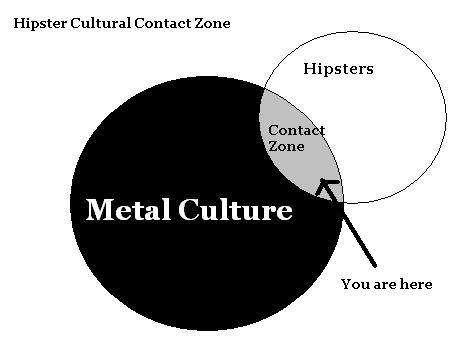
This is where things get interesting. Metal culture and Hipster culture exist completely independent of one another. Metal culture formed and existed for decades without hipsters, and hipster culture formed and exists without metalheads. So it’s safe to say we’re talking about two separate cultural spheres. Now, these separate cultural spheres invariably share a demographic population. Because of this, there will be an inevitable meeting of these cultures in what is referred to as a cultural contact zone. In this instance, it looks like this;
The area of overlap that you inhabit (judging by your opinions, and the title of your podcast) is within this cultural contact zone. Which is awesome, diversity in metal fucking rules. But you have a tendency to frame your arguments like you’re speaking on behalf of a culture that does not share all of your opinions or values. Mostly because the topics you bring up, and the values you espouse in doing so, are generally considered to be in the hipster sphere (not the metalhead sphere).
In the interest of fairness, I would like to take a chance to point out there there are both positive and negative consequences to the intermingling of culture within said contact zone. On the positive side, the amount of intellectual discussion and discourse within the metal community has raised considerably. This is a huge plus for the participants and the culture in general, as it helps solidify and re-enforce the culture, it’s norms, and parameters. On the negative side we have posturing, self-aggrandizing preachy articles from “within” the metal community. This is a relatively new phenomenon, and anybody who has participated in the culture for long enough can recognize this. And it’s not confusing correlation with causation – I’ve already outlined how easy it is to find ties between hipster culture and the SJW-style argument both inside and outside of metal.
Any question that this is anything other than a hipster phenomenon can be quickly reconciled by examining historical socio-cultural interactions between metal and mainstream culture. First, I’d like to put the hipster insurgency into the greater context of cultural insurgencies in metal.
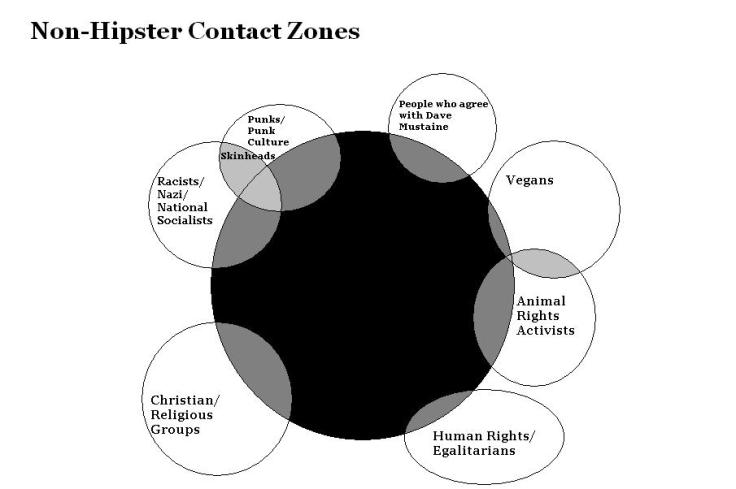
Here, for the purpose of discussion, are a few pre-hipster examples. To do any of these examples true justice would warrant writing another article, so we’re going to do the cliff-notes version.
Every single one of these groups represents a cultural contact zone within metal culture. This is because all of these outside groups share at least part of a core demographic of the population of metal culture (just like hipsters). Now, when there was a Christian insurgency into the metal demographic, it was never viewed as anything other than that. The NSBM contact zone is certainly an area that warrants discussion, but is a relatively low area of concern because of the insular nature of the belief system of that culture combined with their relatively unpopular belief system. Vegans and animal rights groups, and individuals subscribing to those cultures, have successfully used metal as a springboard/outlet for their political views. A good example of this would be the band Cattle Decapitation. At the same time, you have a demographic that agrees with Dave Mustaine, and that guy is obviously fucking nuts (but I would guess you already know that). I, personally, take him less seriously than the whole skinhead/nazi/national socialist populations while finding him equally repugnant.
In this context, you can see that some groups were more successful than others in integrating some of their beliefs/practices/customs into broader metal culture. Without the punk contact zone, for example, we would not have crossover or thrash. In turn, we wouldn’t have extreme metal, or this conversation.
Now in terms of metal culture’s responses to criticism, and other outside forces – I would turn your attention to the PMRC and the satanic panic, which used heavy metal as their chief bogey-man. You also had the trial of Judas Priest. In all of these cases, members of heavy metal culture pretty much banded together and affirmed that nothing they were accused of was even remotely close to true. This is still a common core of the culture nowadays – if you read Randy Blythe’s book he talks about how the occasional metalhead would pop up throughout his ordeal and make it a little more bearable.
One thing we don’t see, however, is criticism of the values and practices of metalheads from within the culture. This reinforces the assertion that SJW style criticism is a phenomenon unique to the millennial generation, specifically the hipster sub-derivative phenomenon named for their actions and style of discourse.
History has shown that people who participate in but are averse to the values of metal culture generally wane or drop off entirely from participation in, or identification with, it (in anything other than the past tense). These people are generally referred to as “tourists”, as well as more colorful and commonly used terms.
And one of the reasons metalhead culture generally stresses learning it’s history in context is to prevent self-aggrandizing statements of ignorance of historical context and the bigger picture.
Now that we’ve got that out of the way – I would like to go point by point on your discussion with the college professor in regards to his article and subsequent responses.
Social Justice Warriors do, in fact, exist. Not as some nameless, faceless “other”, but as a manifestation of current mainstream popular youth culture. As such, they do not exist as a singular, organized, and readily identifiable group because they are a sub-sub-cultural manifestation that draws identifiable traits from the pool of the parent sub-culture. It’s a small cultural movement, not an organized (and by definition) bureaucratic group with clear boundaries. Any attempt to label them as anything other than this is self-delusional at best.
Boycotts/Protests/Etc are certainly protected by the constitution. But there are limits, as there are with every single right guaranteed to American citizens. The actions of that protest at the Taake show were the political equivalent of yelling “fire” in a crowded theater. Neither the protest nor the example of yelling fire are constitutionally protected as they infringe on the rights of fellow citizens. Your rights end where your nose begins.
The crux of the guy’s argument was that people like you are invading the metal scene. You knew it, he knew it, and we all know you were picking a fight and asking leading questions. The fact that you would do that to a fellow journalist and metalhead who’s obviously been around the block more than you have really bothers me. Not that I believe in the myth of a brotherhood of metal, but it’s safe to say that a guy who’s been fucking teargassed at a GWAR show might know more about SJW’s (and the politically correct insurgency in heavy metal) than a person who types a lot. How you made it to both Metal Injection and Invisible Oranges I’ll never know, but they should be ashamed of themselves for not proof-reading your articles at very least – and at the most allowing you to represent their respective establishments. Your lack of historical context is staggering, and to boot you’re a bigger turncoat than Robb Flynn.
I’m sorry you’ve received death threats – but maybe this is one of the consequences of free speech you’re talking about? I’m not saying it’s ok (quite the opposite), but it is a logical consequence of your words and actions. Metalheads aren’t a fun group to pick a fight with. And you have to own up to and accept the responsibility of your own actions and words before you tell other people to do so.
At this point, Shayne, I’m done speaking with you because you weren’t honest with your intentions, and from your last email, its quite clear you are seeking “gotcha questions.” I have no problems speaking with the media about issues I raise but you have to come with a bit more honesty.
Don’t contact me again.
Sincerely,
Jeff
This is nothing more than an old dog of the metal scene not rising to the ruse of a young pup who wanted to pick a fight and prove he’s smarter than a college professor. How you could even pretend to be satisfied that anything you did or said in this exchange (other than honoring his request to terminate it) is beyond me. It’s littered with logical fallacies (like the straw-man SJW argument) and self important pretense masked as genuine concern for a scene you more than likely will not be a part of within the next 10 years.
Also, Metalsucks did a better job with the subject than you did, but I still disagree with the premise.
I am more than open to a continuing discussion and having an open dialogue with you on the subject, and will be waiting to hear your response.


 Artistic rendition of the crossroads transaction between the Devil and Michael Akerfeldt



 Visual representation of “Poser Type A”






 metal stuff