I was talking with my friend Raven from “The Vault of Metal” the other day about an interview with Chester Bennington from Linkin Park, in which he stated, “In my opinion, we actually kept metal alive.”
Now Raven (who isn’t alone in this opinion) contends that the “metal” as represented by bands like Linkin Park, Disturbed, Five Finger Death Punch, Slipknot, and the like isn’t even metal. There are elements of this statement that I sort of agree with, but I have to respectfully disagree with the overall statement.
The reason I disagree is because I think there’s a more accurate way to look at the situation. Metal has two faces, a public (or mainstream) face and a private (or underground) face. This isn’t some new or revolutionary observation – it’s an argument that’s been going on since the genre fractured. It’s been covered by every single major metal sociologist; Deena Weinsteen (Heavy Metal: The Music and Its Culture and Heavy Metal: A Cultural Sociology), Robert Walser (Running With the Devil: Power, Gender, and Madness in Heavy Metal Music), Ian Christe (Sound of the Beast: The Complete Headbanging History of Heavy Metal), Malcolm Dome (The bible of Heavy Metal: Encyclopaedia Metallica, Thrash Metal), Keith Kahn-Harris (Extreme Metal: Music and Culture on the Edge), Sam Dunn (Metal: A Headbanger’s journey, Global Metal, Metal Evolution, Banger Films) in some form or another.
The reason that metal culture as a whole can have these opposing factions is because it isn’t a single, unified culture. It’s what’s commonly referred to as a bricolage culture – a hodgepodge collection of distinct groups and scenes with a unifying theme (metal) that form a complete culture.
For the purpose of this article, metal can be viewed like this;
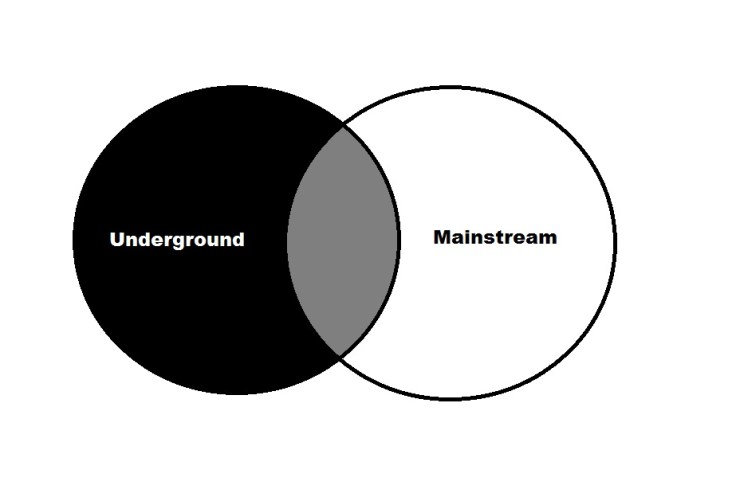
Both sides have their positive and negative aspects. An underground band has the ability to gain a significant amount of credibility within the scene, at the expense of a smaller fanbase. A mainstream band has the monetary advantage, as mainstream viability means you’re reaching a broader audience. However, the price of mainstream popularity comes at the expense of a band’s credibility within the broader metal scene. And in metal, credibility is everything.
Bands are not stuck in a single category, movement between these areas is fluid – but with a catch. They can only move in one direction. A mainstream band cannot under any circumstances move back to the underground. An underground band, however, has the ability at pretty much any point in time to move to the mainstream. There’s even a (often overused) term for when a band moves into mainstream territory – selling out.
To become popular, most underground bands tend to try and stay in the grey area between mainstream and underground – maximizing the size of their audience while sacrificing as little credibility as possible.
So, it’s not really a dichotomy. It’s more of a “collage spectrum” that’s defined by the polar extremes.
Cultural fracture point – when metal gained two identities
When metal actually fractured into these two distinct categories (mainstream and underground) is up for debate. The divide became recognizable when Thrash (underground) and Glam (mainstream) arose as two distinct entities in the 80’s. That’s when we got terms like “lite metal“, which were used by members of the underground community to refer to their mainstream counterparts.
Arguably, the divide between mainstream and underground metal goes back another generation. When Def Leppard refused to be associated with/included in the NWOBHM, band members stated it was because they wanted their band to be associated with the greater “hard rock” category (as opposed to the niche underground genre that NWOBHM was at the time). And if you look at the first wave of mainstream metal (Glam), you can clearly see it’s roots in the styles of both Def Leppard and Led Zeppelin.
I think it’s worth mentioning that bands that existed within the cultural sphere of heavy metal before the mainstream/underground fracture are immune to this classification. It was created to differentiate the new bands, and any attempt to use them as anything else would be inaccurate.
Metal in the Mainstream
It all started with Hair Metal/Glam in the 80’s, which combined metal with popular hard rock from the time period. And as with anything mainstream, hair metal was beholden to corporate influence. So when the music industry had completely exhausted the genre (through formulaic “clone” bands and over-promotion), they moved on to “the next big thing” and declared metal dead. So, in the eyes of mainstream culture – metal had died. And in it’s place was a new mainstream genre – Grunge.
Grunge was effectively the anti-thesis of hair metal. It’s combination of metal and alternative rock pushed apathy and mediocrity as a counterpoint to hair metal’s excitement and over the top excess.
In fact, the only thing I can think of that Glam and Grunge have in common is the incredible amount of heroin band members from both genres consumed. Which, in it’s own way, helped define their shelf lives. I guess every cloud has a silver lining.
Then in the mid 90’s a new mainstream contender entered the arena – Nu Metal. Combining rap with elements of alt-rock/grunge and heavy, down tuned riff oriented metal on (typically) seven string guitars. While musically much more aggressive and exciting than it’s predecessor, it remained a relatively simple and easily digestible form of metal that was fit for mass consumption and easily duplicated by the record industry.
The mid 2000’s saw the fall of Nu Metal and the rise of Metalcore. Taking the already established hardcore/metal fusion that had been mixing with the Gothenburg brand of Melodic Death Metal (and adding the signature whiney Emo vocals), metalcore took the mainstream by storm.
Nowadays, as metalcore is waning in popularity, bands like Periphery and Liturgy are crossing one of underground metal’s more extreme sub-genres (Black Metal) and mixing it with apathetic, “self absorbed posing as introspective” hipster Indie rock genres like Shoegaze to create the musical abomination known as blackgaze. Combined with the large number of bands aping djent and mixing it with mainstream influences, it’s only a matter of time until we see the next big trend in popular metal.
I’m not sure where the fuck Five Finger Death Punch fits into all this, probably the fact that they mixed the groove metal of Pantera with mainstream hard rock. However you want to categorize them, calling them anything other than mainstream metal is a disservice to the intelligence of both the speaker and the listener.
Metal in the Underground

(This is where the magic happens)
Recently Thrash, Death, and Black metal have all been encompassed into an overarching umbrella term – Extreme metal. A fair description, as they all tend towards extremity. I like the term, and it puts all the bands in a proper context – all extreme metal is in some way shape or form a derivative of the thrash metal movement of the 80’s, although bands such as Celtic Frost, Bathory, and Venom (generally dubbed the “first wave” of black metal) also serve as the genre’s precursors. I’m pretty sure Keith Kahn-Harris does a better job explaining it all in his book. Also, Sam Dunn did an excellent crowdfunded “lost episode” of his series Metal: Evolution dealing with the subject.
Exceptions
While metal has been, since it’s inception, a predominantly underground phenomenon, when referring to “underground metal” people are generally talking about thrash and it’s derivatives. Like I mentioned earlier, this split happened after bands like Sabbath or Maiden hit the radar, so while they would fit the mold for underground metal – they also (by standing the test of time) fit into the mainstream metal category. They’re neither and they’re both.
It is interesting to note that in the vein of these classic bands, metal in the underground follows a generational musical progression that’s the only consistent pattern in heavy metal since it’s inception – the new stuff is always heavier. It’s harder, it’s faster, it’s more distorted, and it’s progressively more socially transgressive. Sam Dunn touched on this in his first movie, Headbanger’s Journey – new generations of bands continue to strive to sound heavier than the generation before them.
Conclusions
In context, Raven’s assertion that the “mainstream” metal bands aren’t metal at all is technically true. In every incarnation, the thing mainstream metal bands all have in common is that they dilute heavy metal by mixing it with a more “palatable” style of music. With hair metal, it was diluted with hard rock (including rock ballads, ugh). Grunge watered the heaviness down with popular college alternative rock. Nu Metal did it with rap and alt rock. Metalcore did it with emo. And modern day hipster bands do it with Indie rock (Indie meaning hipster/millennial co-opted melancholy, boring, crap rock – not indie as in independent… there’s a huge independent streak in underground metal).
Saying these mainstream bands “aren’t real metal” isn’t (generally) meant as an insult, it’s an attempt to keep accuracy in the conversation. Metal is generally viewed as genealogical, so an example of that ilk might bring some clarity.
If you breed a horse and a donkey together – the resulting creature is called a mule. It’s not a horse, and it’s not a donkey. The two animals are closely related and branch from the same evolutionary family, but distinct enough to warrant a different name for each distinct species. A mule, the resulting offspring from the union of the species, cannot accurately be called a horse or a donkey because it is equal parts horse and donkey. However if the mule proves fertile (most often they’re not) and is bred with another horse, the resulting offspring will be categorized as a horse.
Substitute “metal” for “horse”, and “rock” for “donkey”, and you essentially have the entire argument against “mainstream metal” being considered part of the metal family tree (instead being relegated back an evolutionary step to the “hard rock” category). If any of the mainstream/popular genres spawn/influence new music by being crossed back with metal genres – the result is considered to be part of the metal tree.
I always figured this sort of knowledge was just a given, but apparently it’s not. the massive amount of butthurt expressed online by hipsters and others outside the metal community when they’re improper use of terminology is corrected just seems to be part of the social landscape.
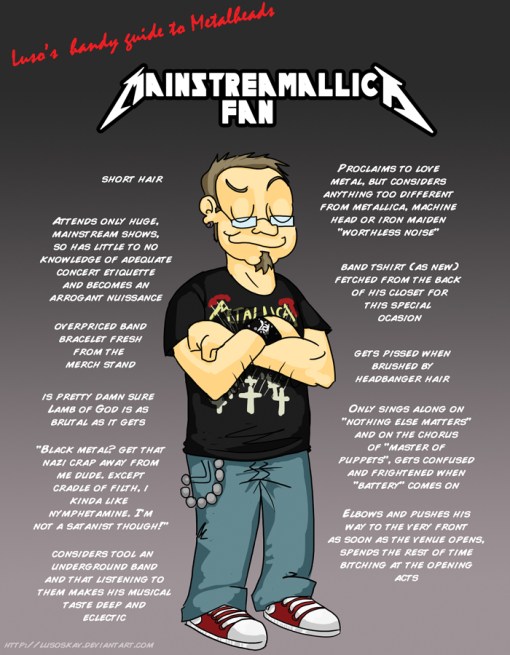
This duality within the genre is also the source of endless frustration expressed in memes like this gem…

Now, as someone who was a pretty big fan of Nu Metal, I might be a tad biased in my opinion. I prefer a touch of holism with my definition of metal – while I’m predominantly a fan of the underground/extreme branch of the metal family tree, I refuse to discount the importance of mainstream metal bands to the culture.
First and foremost, they represent the social gateway into greater metal culture. Nobody starts off listening to Extreme Metal, taste progression in metal is generally a process – and “Gateway Metal” bands generally kick-start the process. They also represent the metal community to the mainstream in other respects.
When the PMRC kickstarted congressional hearings on heavy metal in the 80’s, they completely neglected to mention underground bands. It was Dee Snider of Twisted Sister who went and spoke for the genre, and completely exposed the entire debacle for what it was – a modern day witch hunt. Slipknot and Marilyn Manson (as well as Ozzy, Preist, and Maiden – but if you’ve been reading they’re excluded from this classification as they encompass both mainstream and underground characteristics) were publicly scapegoated as the reason behind public controversies. From grave robberies to school shootings, as soon as heavy metal is found in the mix it’s automatically considered the cause.
So, these aren’t just the people who recruit new member to the metal cause, they’re the ones who defend it in the public eye. They also transmit the norms of metal culture to new recruits. Considering these critical roles mainstream metal bands play in the overall culture, I don’t believe it is accurate to call them anything other than metal.
This doesn’t mean I won’t call a spade a spade, mainstream metal is gimmicky as hell and has a lot of elements of mainstream culture I generally try to avoid. But you can like, or at very least appreciate, a band and the role they play in overall culture without dismissing them because they A) fill a different cultural niche than underground bands and B) don’t conform to a minimalist definition of metal.
Shameless plug, if you like what you read feel free to join my metal facebook group Metal Stuff.




 metal stuff