Search

metal stuff

It's stuff, about metal

Tag

groove metal

What, Exactly, is Groove Metal?

Introduction

It’s no secret that I’m a huge fan of the sub-genrification of metal. There’s just so much metal out there, they’re kind of necessary. A sub-genre is essentially a quick label used (mostly by fans) to describe bands with similar sonic characteristics.

For pretty much every major sub-genre, most fans will be able to list a couple big name bands that exemplify the sound. With Thrash, you’ve got the big four (bay area) and the big Teutonic four (Germany).

Death metal has bands like Death (obviously), Morbid Angel, Deicide, Nile, Obituary, and Suffocation bringing up the oldschool end of things – and (being the most popular sub-genre in the world) probably several thousand other bands branching off into even more subgenres.

With Black Metal you’ve got the first wave guys like Bathory, Celtic Frost, and Venom. And then there’s the second wave guys who pretty much defined the genre as most people know it today – guys like Darkthrone, Mayhem, Burzum, etc.

Power metal, Doom, Melodic Death Metal, Glam, Nu Metal, Grindcore – they all have very distinct, easily identifiable sounds. Within a couple of second of listening to any song within these genres, it’s easy to identify where it belongs in the metal family tree.

Except for one. Groove metal.

It’s weird – this is one of those genres that a lot of people know about. Everyone I’ve ever talked to about the topic can list off a few Groove Metal bands. Which is great – except there’s almost zero overlap. If you talk to three different metalheads about Groove Metal and ask for a list of Groove bands – you’re most likely going to get three very different lists. Even the definitions of Groove Metal vary from person to person. It seems like the only band that people can consistently agree falls in the Groove category is Pantera.
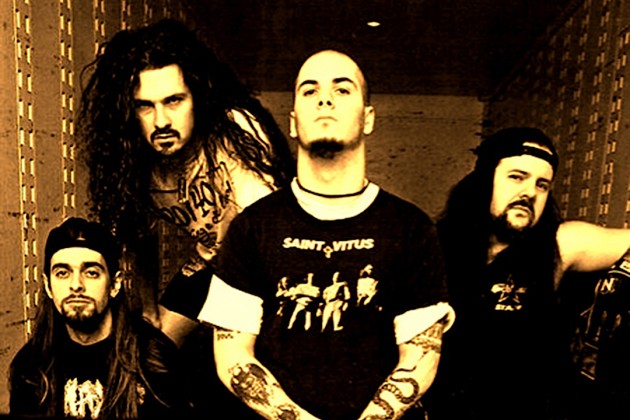
pantera

Now, there is a pretty big group of people who argue that Pantera (post glam, naturally) is a thrash band.

The argument has some merit, but I have some problems with it. Pantera, like most thrash bands, is a very aggressive riff oriented outfit. However, while thrash is typified by fast tempos, Pantera is generally a mid tempo band by comparison. Also, they generally tend to ride what’s known as “the money riff” for the majority of a song. While this isn’t unheard of in thrash, in my experience it’s not the norm.

Fleshing out a Genre from the Middle Ground between Genres

So seeing as Pantera is a generally agreed upon forefather of the Groove genre, their relationship with thrash metal makes defining Groove Metal much easier.Bearing this in mind, I would like to express a few opinions that will (probably) be a tad unpopular.

Because of the black album, I contend that Metallica were as influential as Pantera in the consolidation of Groove Metal as a genre. Think about it, the things people complained about on the album – catchy riffs, predominantly mid-tempo (as opposed to the breakneck pace of Thrash). They ride the money riff for the majority of songs. It’s mid-tempo Thrash. It meets all the criteria of Groove Metal.

Sepultura’s album “Roots” is widely credited as a Nu Metal album. Interesting thought, but there is nothing remotely rap/hip hop oriented about the album. I would argue that Groove metal and Nu metal developed side by side, and ended up having a lot of similar qualities in terms of sound. I don’t think anyone with half a brain cell can lump this album in the same category as the Linkin Park discography – I lump Roots squarely in the groove metal category.

Slayer’s misfit album, “Diabolus in Musica”, is described by the band themselves as an attempt to jump on the Nu Metal bandwagon. The only problem is, all they did was down-tune and ride some grooves. No DJ’s, no rapping – I also classify this album as Groove.

When it comes to fleshing out and discussing Groove metal nobody does it better than Banger. Check out their episode discussing Groove Metal below (then like and subscribe to their youtube channel, facebook page, etc). Seriously though, these guys know what’s up when it comes to metal. I would argue any list of the most important people in metal today that excludes Sam Dunn is a total crock of shit.

Groove’s Influence on Other Genres

We’ve already touched on the Nu Metal/Groove connection a bit, but now might be a good time to reiterate. Groove and Nu Metal share a timeline (and in many cases, an audience) – they formed a genres around the same time, and they influenced each other heavily. Example – it’s no secret that Sepultura were heavily influenced by Korn’s first album when they released Roots (another reason people try to lump the album in the Nu Metal category).

Nu Metal is very groove-heavy, and it’s safe to say there’s a significant amount of overlap between the genres.Example: Machine Head did a one off nu-metal album before returning to Groove Metal. This is a perfect example of the overlap between Nu Metal and Groove Metal:

Nu-Metal Machine Head

Groove Metal/NWOAHM Machine Head

Which leads me to the New Wave of American Heavy Metal (which was as much a movement in metal is it is a genre). Besides Machine head, bands like Lamb of God and Chimaira (flag-bearers of the NWOAHM) also fall squarely in the Groove Metal category.

In fact, I would contend that most of that wave of metal bands from the 2000-2010 era wouldn’t exist without Groove Metal (specifically Pantera, but all those Groove pioneers played a part in paving the way for the NWOAHM).

These bands have been known, on occasion, to even pay tribute to the late great Pantera…

Not that only NWOAHM bands cover the Groove legends, but there’s enough bands that have paid tribute through the years (even before Dime died) where you can make a pretty solid inference as to the influence of the band (and therefore the genre).

In Conclusion

Probably the strangest thing about Groove Metal is that it just kind of “happened”. It wasn’t like Thrash or Death or Black metal, where you had a scene with several bands that fleshed out the sound and defined it in a short amount of time. Instead it developed over the course of (at least) two decades, influencing at least two major metal movements as it went.

This is the only time an entire genre was (or ever will be) formed in the empty space between extremely fast (i.e Death Metal, Black Metal, Thrash, Speed, etc) and extremely slow (Doom and it’s derivatives) tempos.

The only genre with stranger origins (in my opinion) would be Djent – who the fuck names a genre with an onomatopoeia?

Why are Hard Rock and Metal Artists Suddenly Drawn to Country Music?


At first glance, this might seem like an odd phenomenon. In their current states, country and metal are polar opposites. And research into the personality type/musical preference connection clearly shows that fans of heavy metal have far more in common with fans of classical music than fans of country. But, the more you look at it, the more it makes sense that there would be a mini “exodus” from metal music to country. And, arguably, it’s a good thing for both genres and their fans.


Background

First and foremost, it needs to be mentioned that country and metal music share a common ancestor in the blues. Early rock and roll acts and early country acts were almost interchangeable – for example, Johnny Cash and Elvis toured together. Elvis is commonly referred to as the godfather of rock and roll (of which heavy metal is a derivative) and Johnny Cash is widely recognized as a progenitor of Country music. In fact, country music at it’s inception was simply a rural version of rock music.

Now, the two genres have had decades to evolve into two separate entities with distinctive fanbases and cultures that (generally) don’t overlap. But there’s always been a common thread connecting the two – the Rolling Stones “Honky Tonk Woman” is a good example. “Southern Rock” bands have kept a fusion between the two genres (rock and country) alive through the decades, but it wasn’t really until the 90’s that country music and heavy metal met and mixed.

No article dealing with the cross-cultural zone between country and metal would be complete without mentioning two bands – Pantera and Hank Williams III. These two groups bridge the gap between the two genres quite nicely. To further the connection – Pantera’s last real album (even though the lead singer, Phil Anselmo, wasn’t part of it) was a collaboration between the band and David Allen Coe entitled “Rebel Meets Rebel“. Artists like Kid Rock and Aaron Lewis from Staind have kept the connection going.

The Present Situation

Within the past year or so, there’s been more of an “exodus” of metal and hard rock artists in some form or another to the country music medium. Now, it’s not always a full blown transition, and it’s actually been going on for a while (technically since the dawn of both rock and country). I think it’s more accurate to describe the country/hard rock/metal phenomenon in terms of a spectrum: Dabbling (One-Off Country Albums, Collaborations)->Fusion Styles->Full Transition Between Genres (Including solo albums/projects).

In the dabbling category we have  Devin Townsend’s side project (Casualties), Nergal from Behemoth’s country/folk album, Jimmy Bower’s (Down/Eyehategod) Country album, Jonathan Davis’ (Korn) collaboration with country artists Big and Rich, Bon Jovi’s Country album, Chuck Billy (Testament) doing his country tribute to Motorhead’s “Ace of Spades”, and considering I don’t know where Aerosmith stands at this moment I’m going to include Stephen Tyler’s country project as well. And Bret Michaels (Poison) country album.

As far as fusion styles – obviously guys like Pantera and Hank III go without saying. The mutual blues ancestor of metal and country music make them more compatible than you’d think at first listen. In fact, due to the Pantera connection we wouldn’t have groove metal without country.

And for full transitions you’ve got Kid Rock (This guy’s such a redneck, it wasn’t that much of a transition. I think he plays the CMT awards semi-regularly), Aaron Lewis (Staind),  David Vincent (fucking Morbid Angel), and Danny Worsnop (Asking Alexandria). So we’ve got Metalcore, Death Metal, Blackened Death, Doom, Nu-Metal, Hair Metal, Hard Rock, Groove, and Prog represented in country music just from the bands mentioned in this article. I’d say that’s enough of a spectrum state that this isn’t a genre specific phenomenon – the appeal seems to be pretty universal among metal artists.

What Metal Culture Can Learn From Country

In terms of the metal community, a look at the current state of country is a sobering reminder that the music industry (all bureaucracy, in fact) can be a very toxic thing . So, as much as people like to go around bashing elitists – that particular core demographic of the metal community is a big part of the reason metal isn’t a shell of it’s former self. The pop machine has literally eviscerated the entire genre of country music, and left nothing but a hollowed out meat-puppet of a shell that they make perform for fans in a mocking, pandering sort of way. Don’t believe me? Check out this video.

This is what the pop machine does – it analyzes a core fan base to find things they like. It then arranges them into a palatable, pre-digested formula with literally zero integrity. Anybody who’s been alive through the 90’s should remember that country music was a pretty big thing back in the day. And in a matter of a few decades, it’s been reduced to a cultural and artistic void. Boots, cold beer, lemonade, lying in pick-up trucks, some sort of romantic rendezvous, and the month of July – hey, throw that in a 4-chord song format with a steel guitar playing in the background and you’ve got a #1 Country hit! Pandering at it’s best, there’s next to zero substance left in the genre. Probably part of the reason metal artists are occasionally dabbling – they’re filling the creative void.

Also, poser bashing is designed to prevent this sort of thing from happening in/to the metal community. Granted sometimes people take it a little too far, but sometimes you have to take the good with the bad. And in this case, a defense against entryism is much better than the alternative.


What Country Fans Can Learn From Metal Culture

Country music, as a culture, has zero defense against entryism. In layman’s terms, this means that there is no cultural “check” or way to stop an outside group from entering into Country music culture and changing it from within.

At first glance, this might not seem like a problem. It didn’t when Country-pop experienced a revival in the 90’s. But, here’s the problem. If any group can gain entry into an artistic culture – that includes a group put together by a record company. And their focus is on dollar signs, not art.

Unfortunately, because record companies already have a lot of money, they can afford to hire people to do studies into what the fanbase likes and doesn’t like (and then plug the results into the pop-machine formula). At this point, it’s not a matter of if or when it happens (because it already has), it’s a matter of what to do about it. I think that country music as a whole can benefit from a little “heavy metal sensibility”.

First and foremost, the artists getting into country are considered staples of their respective metal genres. These are top-notch artists with creative energy to spare. So, you’ve got a bunch of artists entering the scene and playing real music in the creative void left by the pop industry .

Second, I would hope they bring a little of that “elitist” attitude that has helped heavy metal stay out of the clutches of the pop industry for almost 6 decades. Combined with the DIY ethos of metal and punk, it just might be the breath of fresh air that country music needs.

Third, I hope a few metal artists reintroduce a bit more of that rebel attitude country music deserves.

Conclusion

I think it’s good for metal artists to branch out a little bit. Considering how saturated the market is with metal bands right now, it’s certainly not hurting heavy metal at all. And it could make country music tolerable again. Overall, I’d call it a win/win situation.

The Two Faces of Metal

I was talking with my friend Raven from “The Vault of Metal” the other day about an interview with Chester Bennington from Linkin Park, in which he stated, “In my opinion, we actually kept metal alive.”

Now Raven (who isn’t alone in this opinion) contends that the “metal” as represented by bands like Linkin Park, Disturbed, Five Finger Death Punch, Slipknot, and the like isn’t even metal. There are elements of this statement that I sort of agree with, but I have to respectfully disagree with the overall statement.

The reason I disagree is because I think there’s a more accurate way to look at the situation. Metal has two faces, a public (or mainstream) face and a private (or underground) face. This isn’t some new or revolutionary observation – it’s an argument that’s been going on since the genre fractured. It’s been covered by every single major metal sociologist; Deena Weinsteen (Heavy Metal: The Music and Its Culture and Heavy Metal: A Cultural Sociology), Robert Walser (Running With the Devil: Power, Gender, and Madness in Heavy Metal Music), Ian Christe (Sound of the Beast: The Complete Headbanging History of Heavy Metal), Malcolm Dome (The bible of Heavy Metal: Encyclopaedia Metallica, Thrash Metal), Keith Kahn-Harris (Extreme Metal: Music and Culture on the Edge), Sam Dunn (Metal: A Headbanger’s journey, Global Metal, Metal Evolution, Banger Films) in some form or another.

The reason that metal culture as a whole can have these opposing factions is because it isn’t a single, unified culture. It’s what’s commonly referred to as a bricolage culture – a hodgepodge collection of distinct groups and scenes with a unifying theme (metal) that form a complete culture.

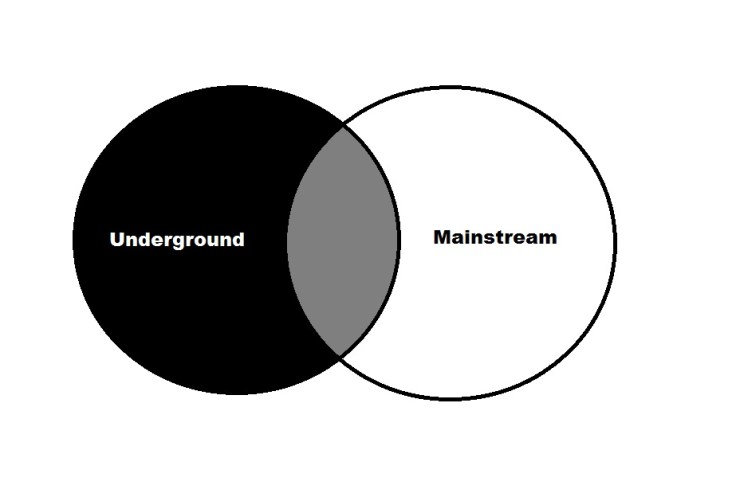
For the purpose of this article, metal can be viewed like this;
twofaces

Both sides have their positive and negative aspects. An underground band has the ability to gain a significant amount of credibility within the scene, at the expense of a smaller fanbase. A mainstream band has the monetary advantage, as mainstream viability means you’re reaching a broader audience. However, the price of mainstream popularity comes at the expense of a band’s credibility within the broader metal scene. And in metal, credibility is everything.

Bands are not stuck in a single category, movement between these areas is fluid – but with a catch. They can only move in one direction. A mainstream band cannot under any circumstances move back to the underground. An underground band, however, has the ability at pretty much any point in time to move to the mainstream. There’s even a (often overused) term for when a band moves into mainstream territory – selling out.

To become popular, most underground bands tend to try and stay in the grey area between mainstream and underground – maximizing the size of their audience while sacrificing as little credibility as possible.

So, it’s not really a dichotomy. It’s more of a “collage spectrum” that’s defined by the polar extremes.

Cultural fracture point – when metal gained two identities

When metal actually fractured into these two distinct categories (mainstream and underground) is up for debate. The divide became recognizable when Thrash (underground) and Glam (mainstream) arose as two distinct entities in the 80’s. That’s when we got terms like “lite metal“, which were used by members of the underground community to refer to their mainstream counterparts.

Arguably, the divide between mainstream and underground metal goes back another generation. When Def Leppard refused to be associated with/included in the NWOBHM, band members stated it was because they wanted their band to be associated with the greater “hard rock” category (as opposed to the niche underground genre that NWOBHM was at the time). And if you look at the first wave of mainstream metal (Glam), you can clearly see it’s roots in the styles of both Def Leppard and Led Zeppelin.

I think it’s worth mentioning that bands that existed within the cultural sphere of heavy metal before the mainstream/underground fracture are immune to this classification. It was created to differentiate the new bands, and any attempt to use them as anything else would be inaccurate.

Metal in the Mainstream

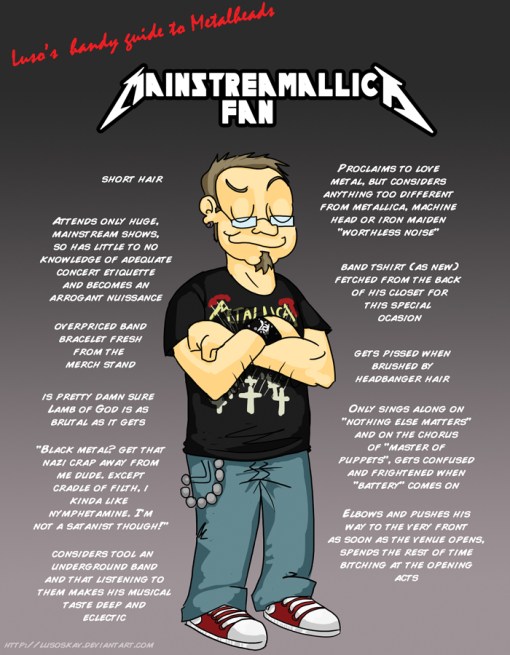
mainstreamallica fan


It all started with Hair Metal/Glam in the 80’s, which combined metal with popular hard rock from the time period. And as with anything mainstream, hair metal was beholden to corporate influence. So when the music industry had completely exhausted the genre (through formulaic “clone” bands and over-promotion), they moved on to “the next big thing” and declared metal dead. So, in the eyes of mainstream culture – metal had died. And in it’s place was a new mainstream genre – Grunge.

Grunge was effectively the anti-thesis of hair metal. It’s combination of metal and alternative rock pushed apathy and mediocrity as a counterpoint to hair metal’s excitement and over the top excess.

In fact, the only thing I can think of that Glam and Grunge have in common is the incredible amount of heroin band members from both genres consumed. Which, in it’s own way, helped define their shelf lives. I guess every cloud has a silver lining.

Then in the mid 90’s a new mainstream contender entered the arena – Nu Metal. Combining rap with elements of alt-rock/grunge and heavy, down tuned riff oriented metal on (typically) seven string guitars. While musically much more aggressive and exciting than it’s predecessor, it remained a relatively simple and easily digestible form of metal that was fit for mass consumption and easily duplicated by the record industry.

The mid 2000’s saw the fall of Nu Metal and the rise of Metalcore. Taking the already established hardcore/metal fusion that had been mixing with the Gothenburg brand of Melodic Death Metal (and adding the signature whiney Emo vocals), metalcore took the mainstream by storm.

Nowadays, as metalcore is waning in popularity, bands like Periphery and Liturgy are crossing one of underground metal’s more extreme sub-genres (Black Metal) and mixing it with apathetic, “self absorbed posing as introspective” hipster Indie rock genres like Shoegaze  to create the musical abomination known as blackgaze. Combined with the large number of bands aping djent and mixing it with mainstream influences, it’s only a matter of time until we see the next big trend in popular metal.

I’m not sure where the fuck Five Finger Death Punch fits into all this, probably the fact that they mixed the groove metal of Pantera with mainstream hard rock. However you want to categorize them, calling them anything other than mainstream metal is a disservice to the intelligence of both the speaker and the listener.

Metal in the Underground

death-metal-bands
(This is where the magic happens)

Recently Thrash, Death, and Black metal have all been encompassed into an overarching umbrella term – Extreme metal. A fair description, as they all tend towards extremity. I like the term, and it puts all the bands in a proper context – all extreme metal is in some way shape or form a derivative of the thrash metal movement of the 80’s, although bands such as Celtic Frost, Bathory, and Venom (generally dubbed the “first wave” of black metal) also serve as the genre’s precursors. I’m pretty sure Keith Kahn-Harris does a better job explaining it all in his book. Also, Sam Dunn did an excellent crowdfunded “lost episode” of his series Metal: Evolution dealing with the subject.

Exceptions

While metal has been, since it’s inception, a predominantly underground phenomenon, when referring to “underground metal” people are generally talking about thrash and it’s derivatives. Like I mentioned earlier, this split happened after bands like Sabbath or Maiden hit the radar, so while they would fit the mold for underground metal – they also (by standing the test of time) fit into the mainstream metal category. They’re neither and they’re both.

It is interesting to note that in the vein of these classic bands, metal in the underground follows a generational musical progression that’s the only consistent pattern in heavy metal since it’s inception – the new stuff is always heavier. It’s harder, it’s faster, it’s more distorted, and it’s progressively more socially transgressive. Sam Dunn touched on this in his first movie, Headbanger’s Journey – new generations of bands continue to strive to sound heavier than the generation before them.

Conclusions

In context, Raven’s assertion that the “mainstream” metal bands aren’t metal at all is technically true. In every incarnation, the thing mainstream metal bands all have in common is that they dilute heavy metal by mixing it with a more “palatable” style of music. With hair metal, it was diluted with hard rock (including rock ballads, ugh). Grunge watered the heaviness down with popular college alternative rock. Nu Metal did it with rap and alt rock. Metalcore did it with emo. And modern day hipster bands do it with Indie rock (Indie meaning hipster/millennial co-opted melancholy, boring, crap rock – not indie as in independent… there’s a huge independent streak in underground metal).

Saying these mainstream bands “aren’t real metal” isn’t (generally) meant as an insult, it’s an attempt to keep accuracy in the conversation. Metal is generally viewed as genealogical, so an example of that ilk might bring some clarity.

If you breed a horse and a donkey together – the resulting creature is called a mule. It’s not a horse, and it’s not a donkey. The two animals are closely related and branch from the same evolutionary family, but distinct enough to warrant a different name for each distinct species. A mule, the resulting offspring from the union of the species, cannot accurately be called a horse or a donkey because it is equal parts horse and donkey. However if the mule proves fertile (most often they’re not) and is bred with another horse, the resulting offspring will be categorized as a horse.

Substitute “metal” for “horse”, and “rock” for “donkey”, and you essentially have the entire argument against “mainstream metal” being considered part of the metal family tree (instead being relegated back an evolutionary step to the “hard rock” category). If any of the mainstream/popular genres spawn/influence new music by being crossed back with metal genres – the result is considered to be part of the metal tree.

I always figured this sort of knowledge was just a given, but apparently it’s not. the massive amount of butthurt expressed online by hipsters and others outside the metal community when they’re improper use of terminology is corrected just seems to be part of the social landscape.

This duality within the genre is also the source of endless frustration expressed in memes like this gem…

girlswholistentometal

Now, as someone who was a pretty big fan of Nu Metal, I might be a tad biased in my opinion. I prefer a touch of holism with my definition of metal – while I’m predominantly a fan of the underground/extreme branch of the metal family tree, I refuse to discount the importance of mainstream metal bands to the culture.

First and foremost, they represent the social gateway into greater metal culture. Nobody starts off listening to Extreme Metal, taste progression in metal is generally a process – and “Gateway Metal” bands generally kick-start the process. They also represent the metal community to the mainstream in other respects.

When the PMRC kickstarted congressional hearings on heavy metal in the 80’s, they completely neglected to mention underground bands. It was Dee Snider of Twisted Sister who went and spoke for the genre, and completely exposed the entire debacle for what it was – a modern day witch hunt. Slipknot and Marilyn Manson (as well as Ozzy, Preist, and Maiden – but if you’ve been reading they’re excluded from this classification as they encompass both mainstream and underground characteristics) were publicly scapegoated as the reason behind public controversies. From grave robberies to school shootings, as soon as heavy metal is found in the mix it’s automatically considered the cause.

So, these aren’t just the people who recruit new member to the metal cause, they’re the ones who defend it in the public eye. They also transmit the norms of metal culture to new recruits. Considering these critical roles mainstream metal bands play in the overall culture, I don’t believe it is accurate to call them anything other than metal.

This doesn’t mean I won’t call a spade a spade, mainstream metal is gimmicky as hell and has a lot of elements of mainstream culture I generally try to avoid. But you can like, or at very least appreciate, a band and the role they play in overall culture without dismissing them because they A) fill a different cultural niche than underground bands and B) don’t conform to a minimalist definition of metal.

Shameless plug, if you like what you read feel free to join my metal facebook group Metal Stuff.

Blog at WordPress.com.

Up ↑